

TL;DR
- Most AI transformation efforts die at pilot stage - not tech failure, but missing organizational groundwork
- This AI-powered transformation guide covers the full framework: pillars, steps, tooling, and where companies blow it
- Five pillars determine success or stall: leadership, data, tech, talent, governance
- Six-step sequence gives repeatable path from audit to scaled deployment
- ROI tracking for AI differs from traditional IT - this guide covers metrics that matter
- Tool recommendations across LLM providers, orchestration, data infrastructure, MLOps
- For CTOs, heads of digital, ops leaders ready to move from experiments to execution
Why AI Transformation Stalls Before It Starts
Most companies don't fail at AI because they picked the wrong model. They fail because they treated structural change as a software purchase.
Proof of concept gets greenlit. Small team builds something impressive in eight weeks. Leadership sees demo, nods, asks when it rolls out organization-wide. Then real work begins - and nobody budgeted for it. Data fragmented. Processes unmapped before automation bolted on. End users never consulted during design. Six months later, pilot still a pilot.
Not a rare story. Default outcome when AI powered business transformation gets treated as software rollout rather than organizational shift. This guide prevents exactly that.

What Is AI-Powered Transformation?
Digital transformation has been a business priority for over a decade. AI-powered digital transformation is its current and most consequential iteration - using artificial intelligence to fundamentally change how organizations operate, decide, and deliver value. Not just automating what exists.
The distinction matters. Digitization replaces paper with software. AI transformation changes what software can do alone. IBM's AI transformation overview frames the shift as moving companies from executing processes to learning from them continuously. Forbes notes that genuine business transformation requires rethinking operating models - not just tooling. Accurate framing for AI too.
Core Pillars of an AI-Powered Transformation Strategy
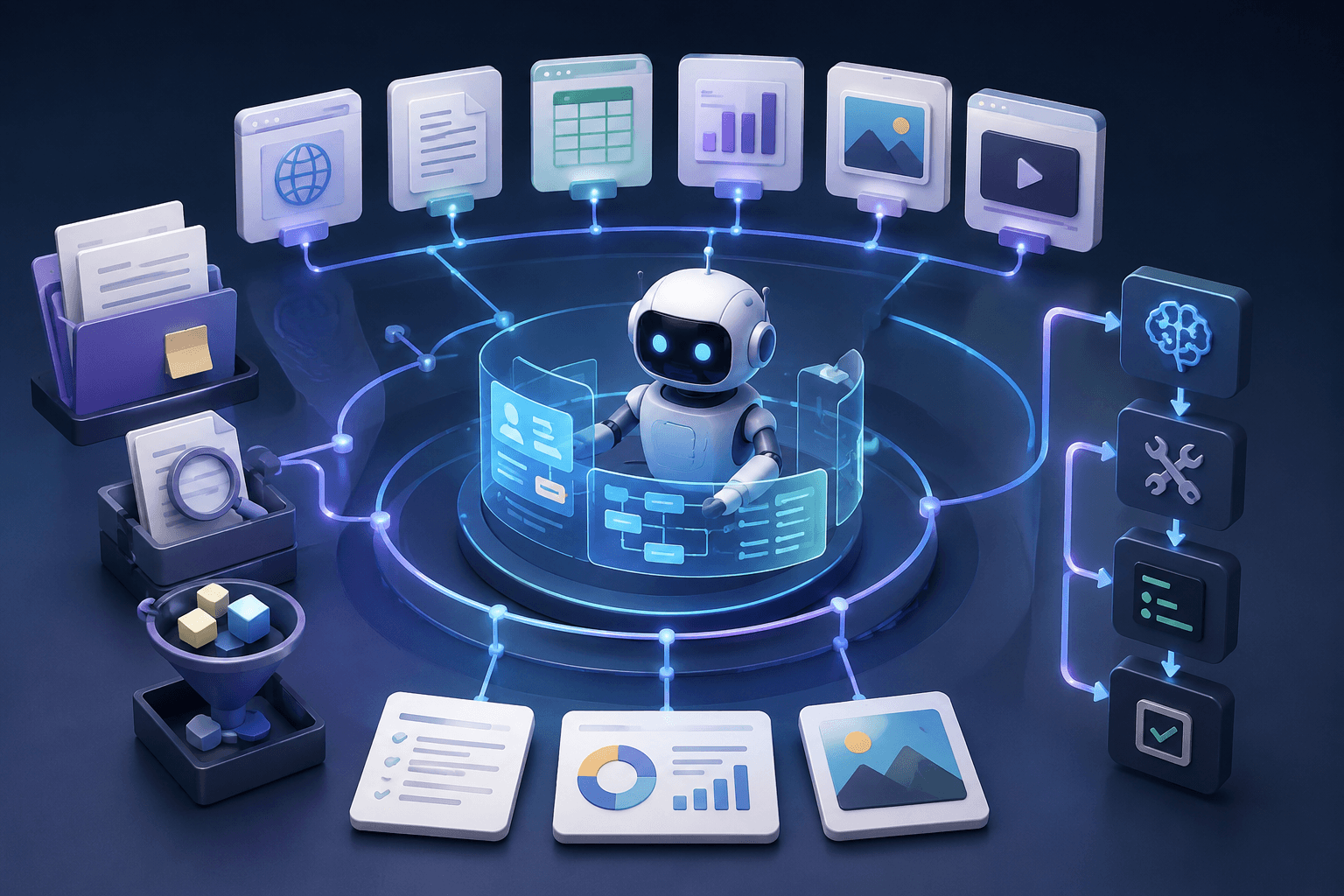
An AI-powered transformation strategy needs structural support before a single model deploys. Five pillars determine whether the foundation holds.
Pillar 1 - Leadership Alignment
Transformation without executive ownership becomes a middle-management project that competes for resources and loses. Leaders need understanding of AI capabilities and limits, realistic expectations, and willingness to absorb organizational friction from real change. Sponsorship is insufficient - active blocker removal separates transformations that scale from those that plateau.
Pillar 2 - Data Readiness
Every AI system is downstream of the data feeding it. Before evaluating platforms or vendors, get an honest inventory: where data lives, cleanliness level, ownership, actual usability for model training or inference. This step gets skipped constantly. Don't.
Pillar 3 - Technology Selection
Stack matters, but it's the third priority, not the first. Technology selection follows clear problem definition and data assessment - it doesn't precede them. Choosing a flagship LLM before knowing which problems to solve is budget misallocation.
Pillar 4 - Talent and Culture
AI systems need people to operate, maintain, and improve them. More importantly, they need organizations where that work gets valued. Culture treating AI as a job security threat generates passive resistance no deployment budget can overcome.
Pillar 5 - Governance and Risk
Model outputs carry real-world consequences. Governance means defining accountability for AI decisions, output auditing, and incident response. McKinsey's technology trends research consistently flags governance gaps as a primary risk factor in enterprise AI deployments. Set this up early - far less painful than retrofitting after an incident.
AI-Powered Transformation Guide: Step-by-Step
This AI transformation framework assumes a serious evaluation - not a standing start.
Step 1 - Assess Current State (Audit + Benchmarking)
Map existing processes before touching automation. Identify where decisions currently get made, how long they take, what data supports them, and where errors occur most often. Benchmark against industry peers where data exists. The audit output surfaces highest-leverage entry points - not a wishlist.
Step 2 - Define Transformation Goals and KPIs
Vague goals ("be more AI-driven") don't survive budget reviews. Specific ones do. Define changes in measurable terms: processing time reduced by X%, decision accuracy improved by Y%, cost per transaction at Z. This forces the conversation about which metrics matter to leadership versus which matter operationally.
Step 3 - Build the AI Stack (Tools, Platforms, Integrations)
Now technology selection happens - informed by problem definition and data reality from steps one and two. Google Cloud's generative AI use cases gives a useful framework for thinking about where generative models fit versus predictive ones. Integrations with existing systems are often the hardest part of this step and the most underestimated in initial scoping.
Step 4 - Run Pilots in High-Impact Workflows
Pick two or three workflows with measurable outcomes, available data, and genuine operational pain. Build, deploy, observe. The pilot stage exists to generate real signal - not validate a decision already made. If the pilot underperforms, that's information, not failure.
Step 5 - Measure, Iterate, and Scale
Pilots hitting KPIs get resources to scale. Those that don't get diagnosed before retry or deprioritization. Measurement cadence matters - monthly reviews are too infrequent to catch drift early. Weekly check-ins against pilot metrics during the first 90 days is a reasonable baseline.
Step 6 - Establish Ongoing AI Governance
Governance isn't a one-time setup task. Models drift. Data pipelines change. Regulatory environments evolve. An AI powered transformation roadmap without a governance maintenance cycle is incomplete. Assign ownership, define review frequency, and build in mechanisms for flagging when model behavior shifts.
Key Tools for AI-Powered Transformation
LLM providers: OpenAI (GPT-4o, o1), Anthropic (Claude), Google Gemini. Choice depends on use case, latency requirements, compliance context, and existing cloud infrastructure. Don't default to the most-hyped option.
Orchestration: LangChain for complex multi-step agent workflows, n8n and Make for automation-layer integrations. For practical workflow automation patterns, these n8n AI workflow examples are worth reviewing before scoping.
Data infrastructure: Snowflake and BigQuery for structured enterprise data at scale. Pinecone and similar vector databases for retrieval-augmented generation architectures.
MLOps and monitoring: MLflow for experiment tracking and model management. Weights & Biases for teams running more complex training workflows. Both solve the same core problem: making model behavior observable over time.
AI-Powered Transformation ROI: What to Track
Standard IT ROI metrics don't map cleanly onto AI deployments. A few distinctions worth making:
Operational efficiency - time saved per process, error rate reduction, throughput increase. Measurable from week one if baselines were established in step two.
Decision quality - harder to quantify but often the bigger value driver. Track outcomes from AI-assisted decisions versus historical baselines.
Cost per transaction - especially relevant for document processing, support triage, and compliance monitoring use cases.
Time to insight - for organizations using AI in analytics and reporting, how much faster do decisions get made? Does that speed translate to measurable business outcomes?
Revenue-facing transformations (pricing optimization, lead scoring) should tie directly to conversion rates or margin data. Without that connection, ROI discussions stay theoretical.
Common Failure Points (and How to Avoid Them)
- Treating AI transformation as an IT project. It isn't - it's organizational change that happens to involve technology.
- Skipping the data audit. Every delayed transformation traces back to data problems that weren't surfaced until late in the process.
- Piloting in low-stakes workflows to "reduce risk." Pilots in workflows that don't matter produce results that don't prove anything. Pick something real.
- No defined success criteria before launch. If you can't describe what success looks like on day one, you won't recognize it on day ninety.
- Underinvesting in change management. The people using these systems need context, training, and a clear answer to "what does this mean for my role." Skipping that creates resistance that outlasts the deployment.
For companies carrying technical debt alongside transformation ambitions, AI-driven legacy modernization is often the prerequisite work that determines how fast everything else can move. This context is also relevant for industrial environments - integrating AI in industrial automation presents a different set of constraints than cloud-native deployments.

How CodeGeeks Solutions Supports AI-Powered Transformation
CodeGeeks Solutions works with companies navigating the full arc of enterprise AI transformation - from initial readiness assessment through scaled deployment. Their AI automation services cover workflow-level implementations that typically form the early phases of a broader transformation. Client reviews are publicly available on Clutch, and the case studies section gives a realistic picture of what's been built across different industries and organizational constraints.
For teams at the evaluation stage, the guide on what makes AI startups succeed offers relevant framing even outside the startup context - the principles around scoping and validation translate directly.
Final Thoughts
A serious enterprise AI transformation guide has to be honest about the gap between how transformation gets sold and how it actually plays out. Technology is not the hard part anymore. Data infrastructure, governance structures, organizational change - those are where transformations succeed or quietly fail.
This AI transformation guide won't guarantee results. No guide can. What it can do: give leaders a clear-eyed framework for making decisions that hold up when implementation gets complicated.
Start with the audit. Define the metrics. Run a real pilot. Then scale what works.
FAQ
What is AI-powered transformation?
Using artificial intelligence to fundamentally change how an organization operates and makes decisions - not just automating existing processes, but enabling capabilities that weren't possible before. Spans every business function and requires structural changes, not just technology adoption.
How is AI-powered transformation different from digital transformation?
Digital transformation broadly covers moving to digital tools and processes. AI powered transformation specifically involves systems that learn, adapt, and make predictions - creating compounding value over time rather than just replacing manual steps with digital ones.
How long does AI-powered transformation take?
Meaningful pilots can show results in 90 days. Full scale organisational transformation takes 2-4 years depending on data maturity, organisational complexity and how seriously governance gets resourced. Anyone quoting a shorter time frame for enterprise wide change is underselling the work.
Which industries benefit most from AI-powered transformation?
Financial services, healthcare, manufacturing, retail and logistics see the strongest ROI - mainly because they have data rich processes, clear cost per transaction metrics and real operational pain that AI can solve. The underlying framework applies across sectors.
What are the biggest risks of AI transformation?
Data quality problems surfacing mid-deployment. Governance gaps creating accountability blind spots. Change management failures generating passive organizational resistance. And the classic one: piloting in environments that can't generate signal meaningful enough to justify scaling investment.