
TL;DR
- AI in industrial automation works best when it augments decisions (maintenance, quality, planning) rather than replacing deterministic control logic.
- The safest early wins usually come from predictive maintenance, computer vision inspection, and anomaly detection.
- Treat integration as a workflow project first, not a model project: data quality and operational fit matter more than “fancy AI.”
- Roll out safely using shadow mode → human approval → selective automation to avoid production disruption.
- Choose edge vs cloud based on latency and reliability: real-time inference often belongs near machines; training and fleet analytics can live centrally.
- Expect security and governance work (segmentation, RBAC, audit trails) to be part of the scope, not an afterthought.
- AI pays off when ROI is tied to downtime cost, scrap cost, and throughput margin - not vague “innovation” goals.
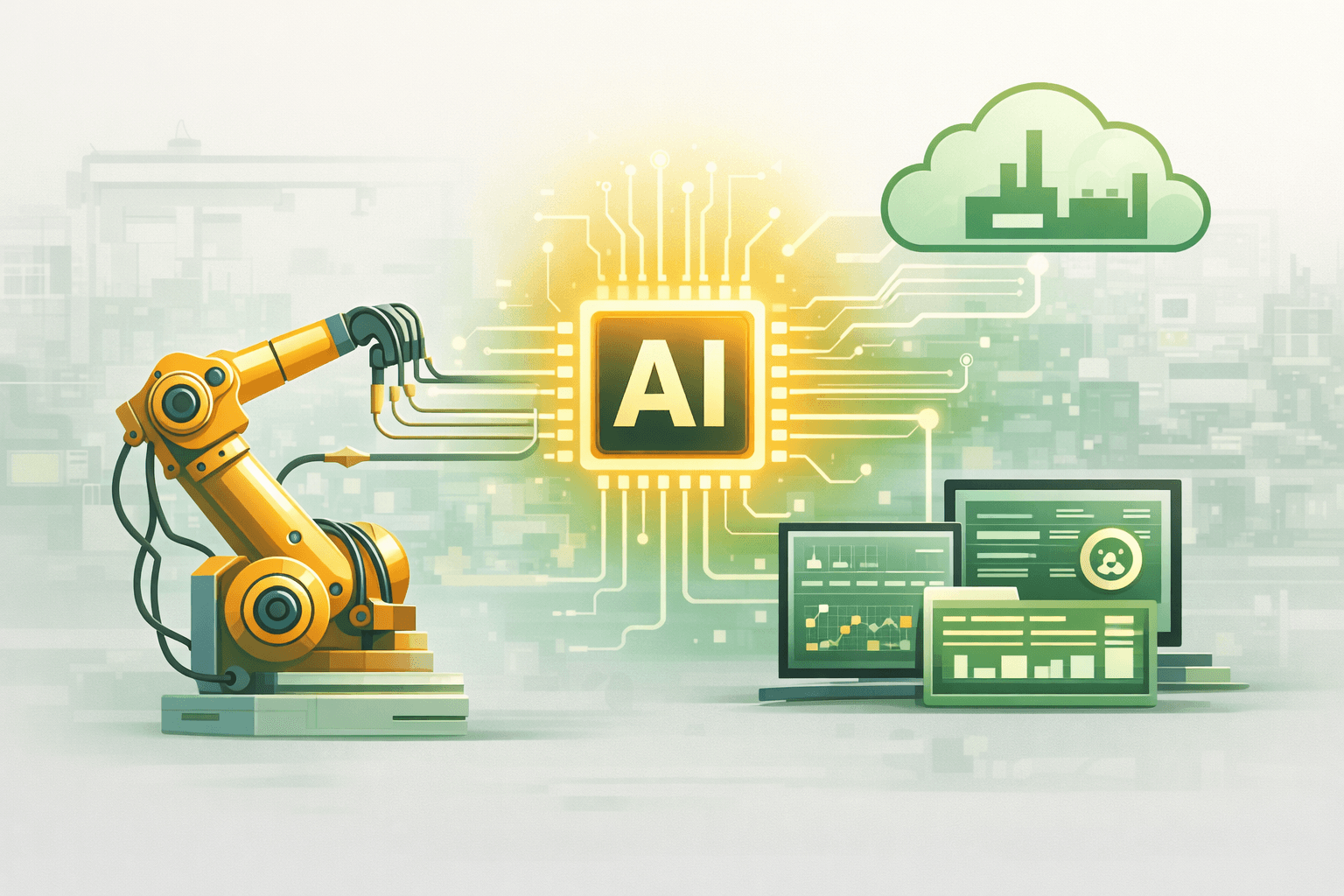
Industrial automation is shifting from fixed rules to data-driven decisions. PLC logic, interlocks, and deterministic sequences remain critical - but the competitive edge increasingly comes from systems that can learn patterns, predict failures, and optimize performance using data already produced by machines and sensors.
That’s the promise of AI industrial automation: reducing downtime, improving quality, and increasing throughput. But the caveat is simple: artificial intelligence in industrial automation only delivers when it’s integrated safely into real factory workflows. When AI is bolted on without a rollout strategy, operators stop trusting it, maintenance teams ignore it, and production gets disrupted - the exact outcome you’re trying to avoid.
This guide covers real use cases, generative AI in industrial automation, and a practical roadmap for how to integrate AI in industrial automation without turning your plant into a beta environment.
What “AI Industrial Automation” Means
AI industrial automation = using AI/ML to make factory systems predict, detect, and optimize (maintenance, quality, anomalies, scheduling) beyond fixed PLC rules, while safety/control logic stays deterministic.
AI vs traditional automation
Traditional automation is deterministic: if condition X happens, do Y. That’s perfect for safety constraints, reliable control loops, and repeatability.
AI is probabilistic: it predicts, classifies, ranks, and detects patterns. In industrial environments, industrial automation using AI typically means:
- predicting failures before they happen,
- spotting defects on the line using vision,
- identifying anomalies in time-series signals,
- recommending process adjustments within constraints,
- supporting planners with better scheduling options.
So the real “AI vs automation” answer is not “either/or.” AI in industrial automation fits best as a decision-support and optimization layer above deterministic control logic - especially early on.
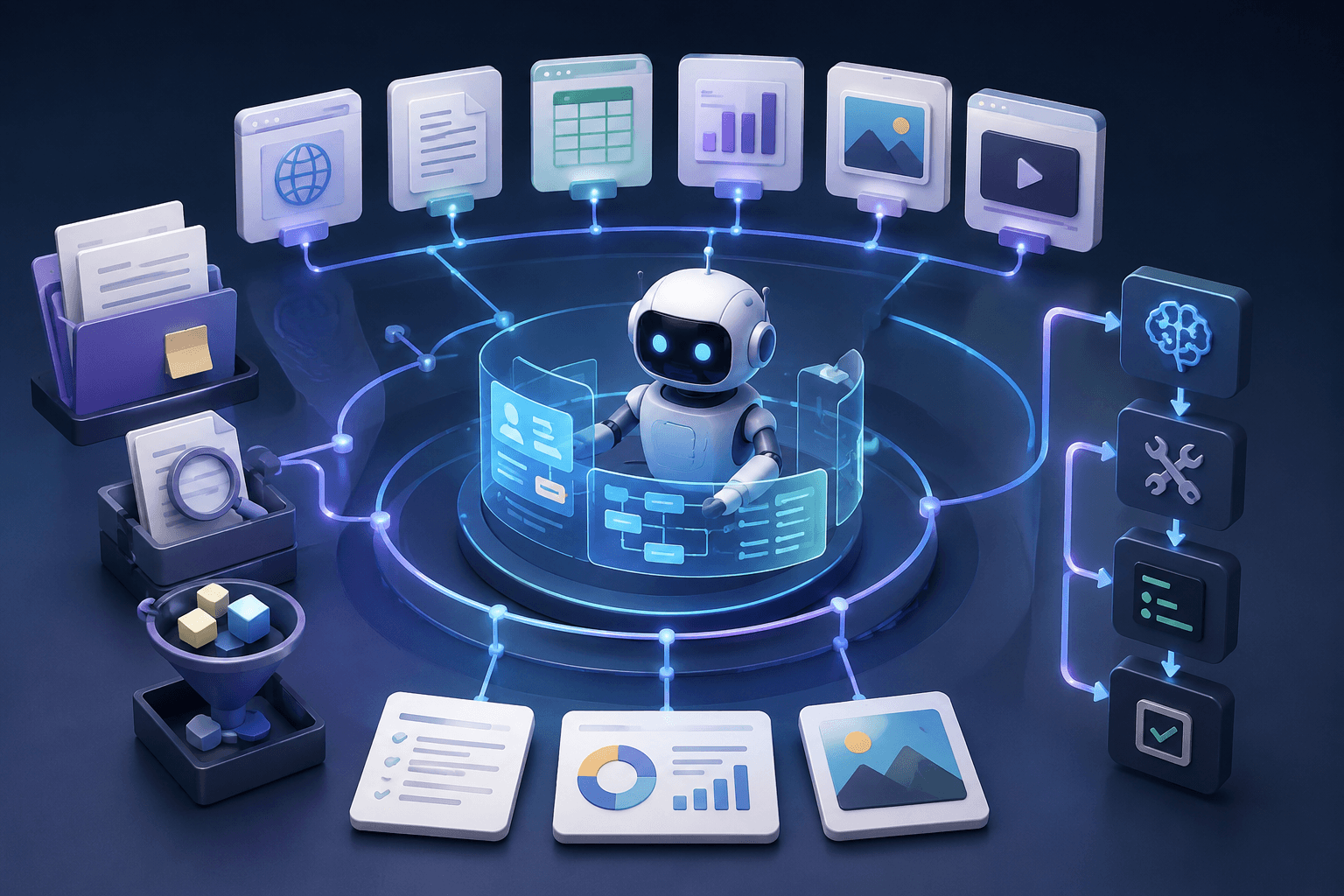
Successful industrial AI integration requires more than deploying isolated models. It involves connecting predictive maintenance systems, quality control analytics, sensor data streams, ERP platforms, and operational dashboards into a unified workflow.
Organizations seeking structured deployment often rely on AI automation services for businesses to design scalable automation pipelines, integrate AI with existing industrial systems, and ensure monitoring, governance, and measurable performance outcomes across production environments.
Where AI fits in the stack
A practical integration map for AI for industrial automation looks like this:
- Control layer (PLC / motion / robotics): deterministic control, safety interlocks
- Supervisory layer (SCADA / HMI): visualization, alarms, operator workflows
- Operations layer (MES): execution, traceability, quality records
- Planning layer (ERP / APS): schedules, inventory, procurement
- Data layer (historian / IIoT platform): time-series, events, context
Most AI to industrial automation projects should begin above the control loop: consume data from historians and systems, then feed insights back into SCADA/MES workflows - starting with recommendations.
If you need a simple taxonomy for stakeholders, this overview of industrial automation domains is a useful starting point for aligning terminology.
The Highest-Impact Use Cases
1. Predictive maintenance
Predictive maintenance uses condition data (vibration, temperature, current, pressure, cycles) plus maintenance history to forecast likely failures and schedule work earlier - before breakdowns trigger unplanned downtime.
A good high-level view of how AI is applied in manufacturing - especially around maintenance and efficiency - is covered in IBM’s primer on AI in manufacturing.
What “success” looks like:
- fewer unplanned stops,
- fewer emergency maintenance events,
- better maintenance timing aligned with production windows,
- higher overall equipment effectiveness (OEE).
This is one of the most reliable AI-driven industrial automation wins because the business value is easy to quantify in downtime minutes.
2. Quality inspection with computer vision
Vision inspection is often the fastest path to ROI: cameras are already present (or easy to add), and scrap/rework costs are visible. With AI in factory automation, vision models can scale inspection coverage and consistency - catching defects that humans miss due to fatigue or speed constraints.
The real integration trick is operational: the model output must connect to a workflow (reject gate, rework queue, traceability record), not just a dashboard.
3. Anomaly detection
Anomaly detection flags unusual patterns in time-series signals - even when you don’t have perfectly labeled failure data. It’s often a practical starting point for AI for factory automation when failures are rare but costly.
Used well, it reduces investigation time: instead of “something is wrong,” teams can see when the system drifted and which signals moved first.
4. Process optimization
Process optimization uses models to recommend setpoint changes or recipe adjustments within constraints. The safest pattern is “recommendations + constraints,” where operators approve changes and the system learns from outcomes.
This is where AI for industrial automation can drive yield improvement and stability - without handing autonomy to a model too early.
5. Production planning support
Scheduling and planning are constraint-heavy: machine availability, changeovers, material constraints, labor, delivery windows. AI can help planners with scenario evaluation and prioritization - especially when tied to real-time floor status.
This is also a sensible home for generative AI in industrial automation: turning SOPs into step-by-step guidance, summarizing downtime notes, and helping engineers navigate internal documentation - without controlling equipment.
For a balanced “boots-on-the-ground” perspective (including skepticism), read this PLC community discussion on AI in industrial automation and what practitioners actually think.
AI in Factory Automation: Where to Start
Teams get momentum when they pick a problem that is:
- expensive (downtime, scrap, yield loss, missed SLA),
- measurable (baseline exists),
- feasible (data is accessible within weeks, not months).
A realistic first project in AI in factory automation is usually one of:
- one critical asset class for predictive maintenance,
- one inspection point with high scrap cost,
- one anomaly detector for a bottleneck step.
This is the practical definition of AI industrial automation: improving a single workflow with measurable outcomes, then scaling.
How to Integrate AI in Industrial Automation
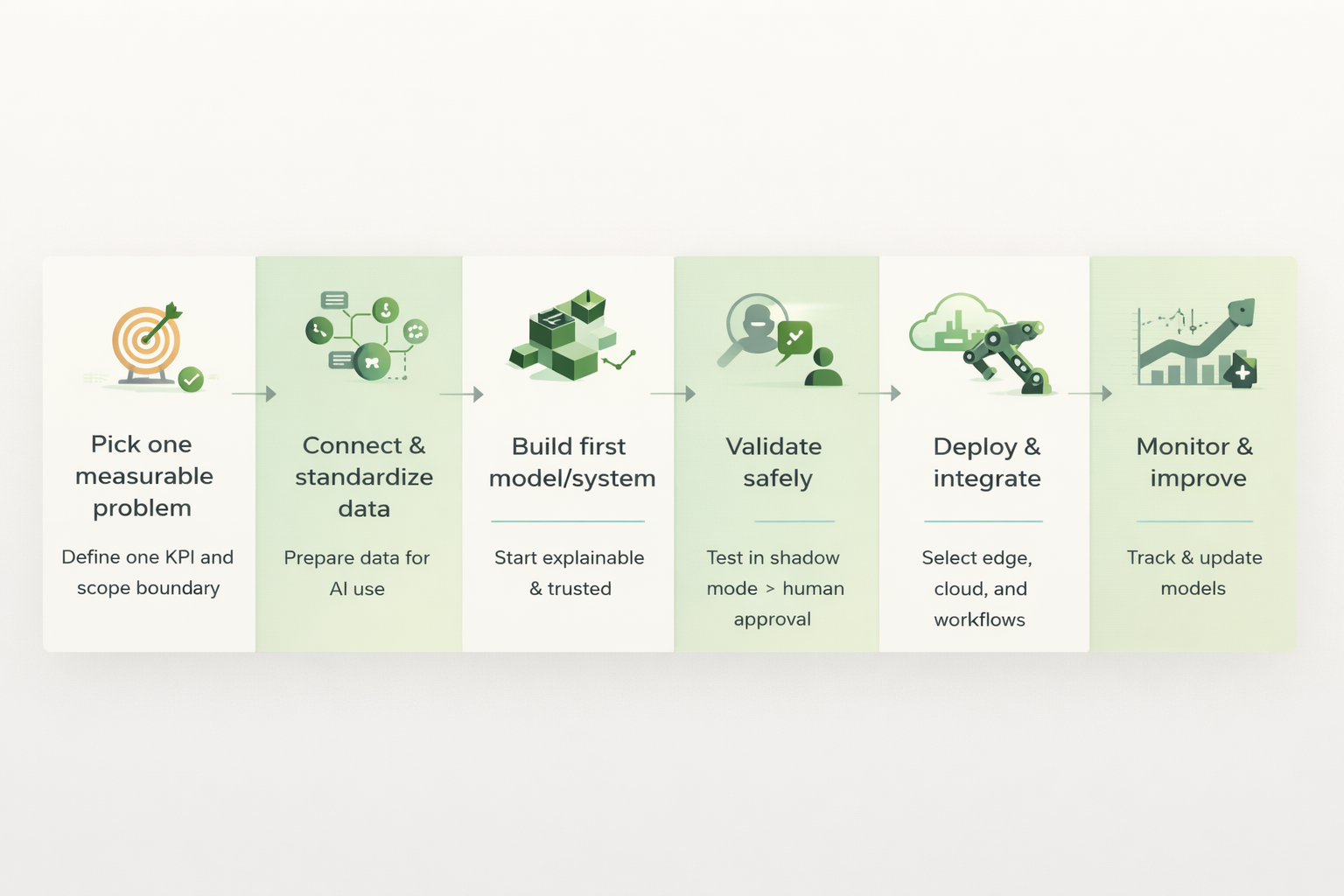
Step 1 - Pick one measurable problem
Define one KPI and one scope boundary:
- “Reduce unplanned downtime on Line 3 by 10%”
- “Cut false rejects at station A by 20%”
- “Detect drift in furnace profile within 5 minutes”
A clear scope is the foundation for how to integrate AI in industrial automation without turning into a vague “innovation” initiative.
Step 2 - Connect and standardize data
This is where most of the real work lives. For industrial automation using AI, you need:
- consistent timestamps and sampling rates,
- stable equipment IDs and tag naming,
- operational context (product type, recipe, shift, operator actions),
- ground truth labels (failures, defects, maintenance events).
Without standardization, AI becomes noise generation.
Step 3 - Build the first model or system
Start simple and explainable. In factories, trust beats sophistication. A “good enough” model integrated into workflows often outperforms a higher-accuracy model nobody uses.
This step should produce not only predictions but also a decision artifact (what happened, why it matters, what to do next). That’s how AI in industrial automation becomes operational, not theoretical.
Step 4 - Validate safely (shadow mode → human approval)
Run in shadow mode first: predictions are generated and logged, but nothing changes on the line. Then move to “human approval required,” where operators accept/reject recommendations.
This rollout pattern is the safety net for artificial intelligence in industrial automation - and the easiest way to build operator trust without disrupting production.
Step 5 - Deploy (edge or cloud) and integrate into workflows
Most teams land on a hybrid:
- inference close to the line for low latency and resilience,
- centralized analytics for training, reporting, and model management.
This is the practical meaning of AI and cloud for industrial automation: cloud helps with lifecycle and fleet intelligence, while real-time decisions often happen closer to machines.
Step 6 - Monitor, retrain, and improve
Factories change: tool wear, supplier variation, new products, sensor drift. Monitoring must include:
- drift in data distributions,
- false positive/negative trends,
- model performance by product/shift/recipe,
- operator overrides and reasons.
This is the difference between a demo and durable AI-driven industrial automation in production.
Data & Security Challenges
Data challenges
- Missing context (you know a parameter changed, but not why)
- Inconsistent defect definitions (“defect” changes by product or customer)
- Rare failures (hard to learn from limited examples)
- Sensor noise and drift (especially in harsh environments)
Security challenges
- OT/IT segmentation and controlled data pathways
- Least privilege access to historians and gateways
- Audit trails for predictions and operator-approved actions
- Clear rollback paths and “do no harm” defaults
If these aren’t scoped from day one, AI in industrial automation becomes fragile and politically painful (“AI broke production”).
Cost and ROI: When AI for Industrial Automation Is Worth It
AI is worth it when it targets expensive variability. A grounded overview of why manufacturers invest in AI - quality, efficiency, adaptability - is outlined in IBM’s AI in manufacturing, and it maps well to industrial ROI drivers.
A simple ROI model:
- Downtime ROI: minutes saved × cost per minute
- Quality ROI: scrap reduction × (materials + labor + rework)
- Throughput ROI: extra output × contribution margin
- Maintenance ROI: avoided failures + optimized labor scheduling
When is AI not worth it?
- the process is stable and already optimized,
- data is too messy or inaccessible,
- outputs can’t be embedded into workflows,
- the cost of wrong recommendations is higher than expected benefit.
That’s why AI for industrial automation should begin with decision support and safe rollout stages.
How CodeGeeks Solutions Delivers AI-Driven Industrial Automation
At CodeGeeks Solutions, we treat AI-driven industrial automation as an engineering integration program: workflow-first, measurable KPIs, and safe rollout patterns (shadow mode → approval → automation). That’s how teams get ROI without disrupting production.
If you’re modernizing operational software alongside factory initiatives, these reads may help frame the “software that fits operations” mindset:
- App development for a construction business (a practical example of building software around real workflows)
- Key benefits of outsourcing software development (how teams accelerate delivery without losing ownership)
If your team wants to integrate AI without risking production stability, start by exploring CodeGeeks Solutions. If you prefer third-party validation, you can review client feedback via CodeGeeks Solutions reviews on Clutch.
Final Thoughts
The biggest mistake is trying to replace deterministic automation with AI. The safer, higher-ROI pattern is layered: keep safety-critical logic deterministic, then add intelligence where uncertainty lives - maintenance prediction, inspection, anomaly detection, planning support.
When industrial automation using AI is integrated through measurable scope, safe validation, and real workflow adoption, it becomes a repeatable program - not a one-off experiment. That’s how AI in factory automation scales across lines and sites without disrupting production.
Industrial AI adoption is not just a technical upgrade — it’s a strategic shift in how operations are managed, optimized, and scaled. From predictive maintenance to intelligent resource allocation, AI must align with business objectives and long-term infrastructure planning.
Companies ready to modernize beyond pilot projects can leverage AI transformation services to align architecture, data strategy, automation workflows, and operational governance — turning AI initiatives into enterprise-wide competitive advantages.
FAQ
What’s the best first use case for AI in factory automation?
Start with the clearest economics and data availability: predictive maintenance on a critical asset or vision inspection where scrap/rework is expensive. Both are proven entry points for AI in factory automation.
Can generative AI control industrial equipment?
Direct control is rarely appropriate. Generative AI in industrial automation is best used as an assistant: summarizing logs, drafting work instructions, helping engineers search SOPs, and supporting planning - while control actions remain deterministic and constrained.
Do we need a cloud for industrial AI, or can it run on the edge?
Many teams use both. Real-time inference often runs near the line for latency and resilience, while centralized analytics supports training and lifecycle. That hybrid approach is the most practical form of AI and cloud for industrial automation.
How long does it take to integrate AI into industrial automation?
A focused pilot can show results in 8–12 weeks if data access is ready. Enterprise rollout takes longer because workflow integration, security, and monitoring matter as much as the model.
What data do we need for predictive maintenance?
At minimum: sensor time-series (condition signals), operating context (load/recipe/shift), maintenance logs, and recorded failure events. The more consistent your tagging and timestamps, the faster AI for industrial automation delivers value.