
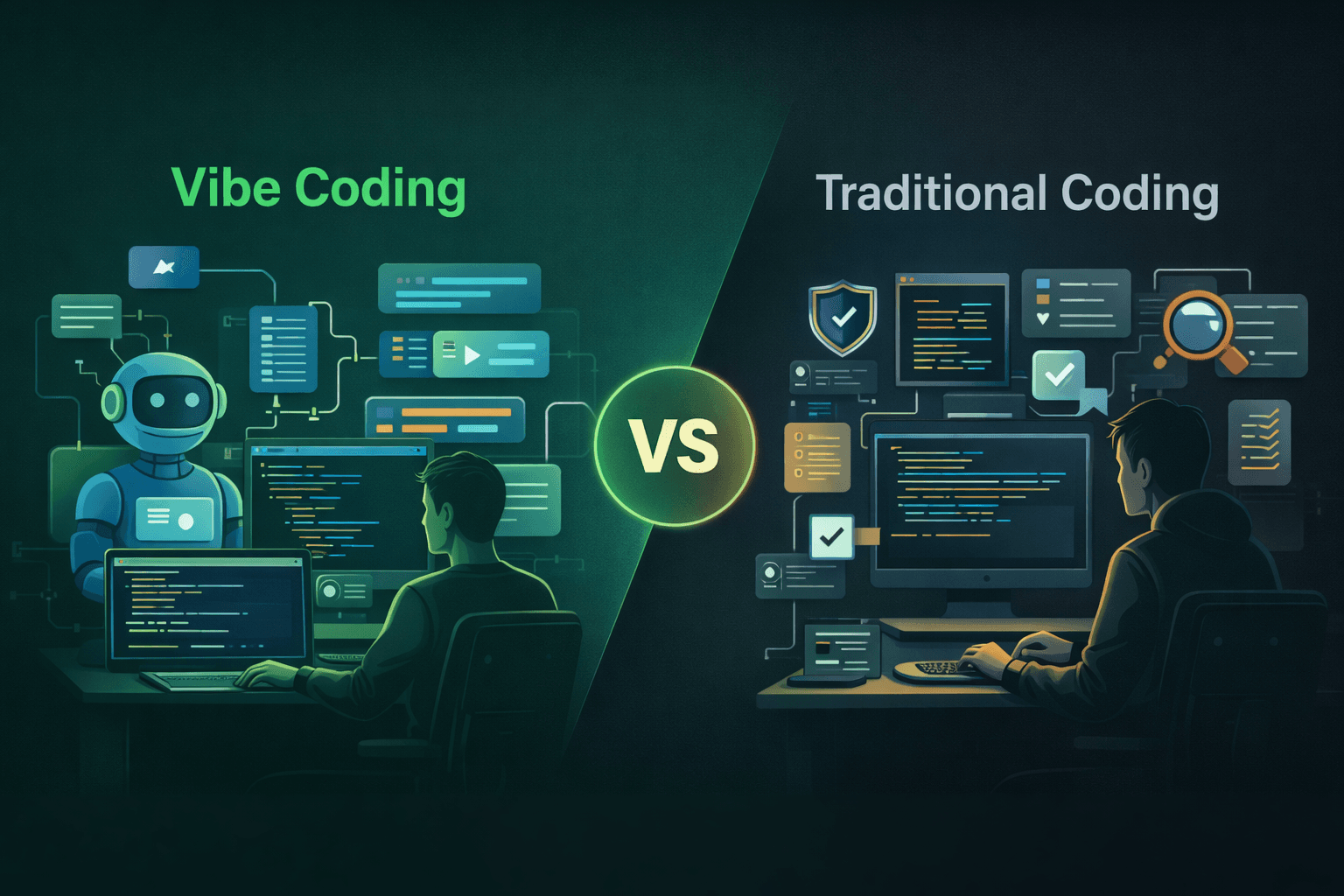
“Vibe coding” is trending because AI tools can turn intent into code in minutes - fast enough to feel like a new way of building products. That’s why the vibe coding vs traditional coding debate is suddenly everywhere: teams are shipping prototypes faster than their engineering processes can keep up.
The problem is predictable: speed without fundamentals turns into bugs, security holes, and a codebase nobody wants to own. Even developers who enjoy the workflow point out that it can be harder than regular coding once you hit complexity and ambiguity - see this thread on why vibe coding can feel harder than “regular” coding.
At CodeGeeks Solutions, we use AI inside professional engineering practices - so you get acceleration without “prototype debt.”
What “Vibe Coding” Actually Means
Vibe coding is a prompt-first workflow: you describe what you want, AI generates code, you run it, and you iterate - often with minimal reading until something breaks. Google’s overview of what vibe coding is frames it as a natural-language-driven creation with AI doing much of the heavy lifting.
In practice, vibe coding isn’t “AI-assisted development” in the disciplined sense. It’s closer to: move fast, accept uncertainty, keep nudging the model until the app behaves. A solid breakdown of the mindset shift is in Coding vs Vibe Coding: the essential difference.
That mindset shift creates the real vibe coding vs traditional coding differences: who owns the architecture, who validates edge cases, and who’s accountable when production fails.
Traditional Coding: Why It Still Wins for Production Software
Traditional coding is slower at the start because it forces clarity: requirements, data contracts, architecture decisions, and explicit error handling. It still wins for production because it scales human understanding - and software is maintained by humans long after the initial sprint.
Many developers who like AI still warn that “working” AI code can be shallow: it passes happy-path tests but misses threat modeling, performance constraints, or long-term maintainability. A very grounded perspective is in this developer’s honest take on vibe vs professional coding.
So in the vibe coding vs traditional programming discussion, the real dividing line isn’t taste - it’s risk tolerance and ownership. AI can help, but production software still needs deliberate engineering.
Vibe Coding vs Traditional Coding Comparison
Here’s a practical vibe coding vs traditional coding comparison you can use in planning. (And yes - this is one of those cases where “it depends” becomes measurable.)
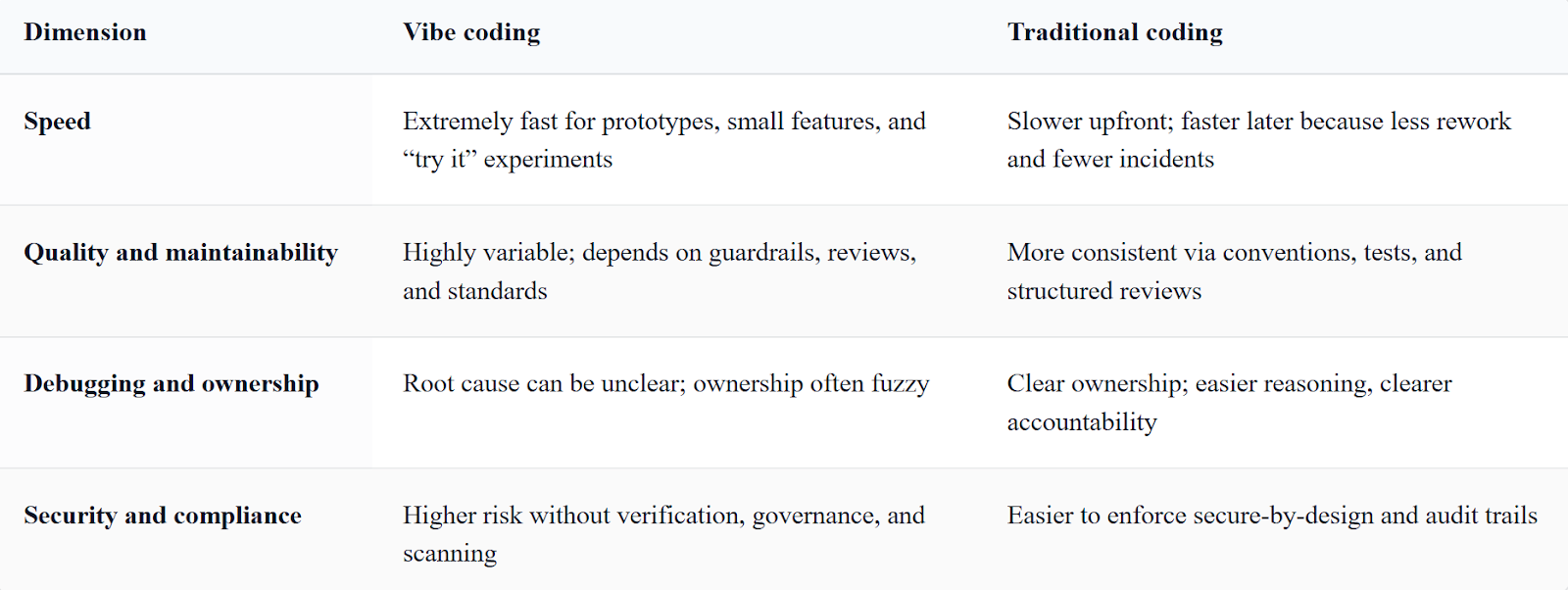
This is where the vibe coding vs traditional coding methods question becomes straightforward: do you want speed now, or stability later - and do you have guardrails to avoid paying the difference twice?
The Real Risk: Using AI Without Skills
The biggest risk is illusion of correctness: AI output looks confident, runs, and even demos well - but can hide security flaws, brittle assumptions, and silent failures. IBM’s overview of AI in software development is a useful reminder: AI accelerates creation, but it doesn’t remove responsibility for verification.
There’s also a human factor. Many devs say AI is helpful, but it can reduce deep engagement - especially when people stop reading code and only “steer.” This thread on AI helping while taking the joy out captures that tradeoff. Less reading → weaker intuition → higher long-term risk.
To mitigate this risk, teams that have heavily relied on AI-generated code can use structured vibe coding cleanup services. This includes auditing hidden assumptions, refactoring brittle logic, restoring documentation and test coverage, and introducing proper review guardrails. Instead of continuing to build on uncertain foundations, cleanup helps convert fast AI-driven experimentation into stable, production-ready systems.
Vibe Coding Advantages Over Traditional Coding (When It’s Actually the Right Tool)
The vibe coding advantages over traditional coding are real - when failure is cheap and learning is the goal.
Good use cases
- MVP demos, prototypes, and fast UX experiments
- Internal tools where scope is controlled
- Boilerplate generation (CRUD, scaffolding), then human review
- Guided refactoring when tests already exist (AI shines here)
Bad use cases
- Auth, payments, PII, secrets, and regulated workflows
- Large rewrites without characterization tests + rollback plan
- Complex systems where architecture dominates performance and reliability
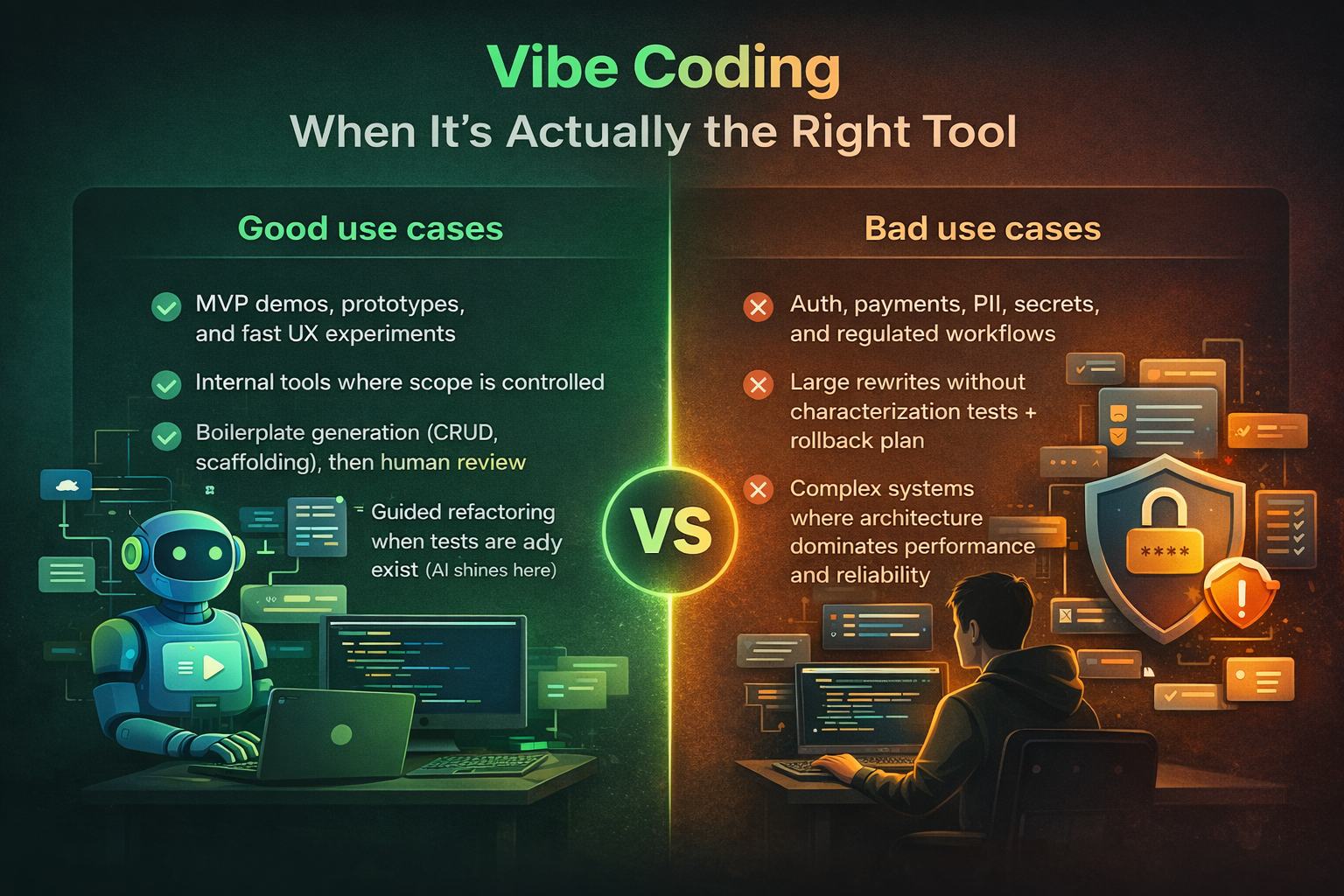
A concise checklist version: vibe coding is great when you can validate quickly and throw away safely.
A Simple Decision Framework: Vibe Coding or Traditional Coding?
If you’re deciding vibe coding or traditional coding, answer these 8 yes/no questions:
- Is this a prototype/experiment (not mission-critical)?
- Do we have tests (or can we add them before shipping)?
- Is there a clear owner for the code for 6–12 months?
- Does it touch auth, payments, PII, or secrets?
- Do we need compliance evidence (SOC 2 / ISO / HIPAA / GDPR)?
- Can a human reviewer explain the code’s intent and risks?
- Do we run CI checks (lint, SAST, dependency scanning)?
- Do we have monitoring + rollback if it breaks?
Recommended outcomes
- Mostly YES to 1–3 and NO to 4–5 → vibe coding is fine with review + tests.
- YES to 4–5 or NO to 2, 6, 7 → choose traditional coding vs vibe coding.
- Mixed → combine vibe coding and traditional coding: AI drafts, engineers own architecture, tests, security, and releases.
This is also where vibe coding vs traditional software development stops being a philosophical debate and turns into an operating model.
How CodeGeeks Solutions Uses AI the Right Way
Our approach is simple: AI accelerates execution, but engineering owns outcomes.
- Clear specs + acceptance criteria before generation
- Small, reviewable PRs (no giant “AI dump” commits)
- Tests first (or characterization tests before refactors)
- Security gates and dependency hygiene
- Observability + controlled rollout
If you want concrete guardrails, we’ve published internal rules in Best Practices for AI Refactoring Legacy Code and expanded the philosophy in Vibe Coding and AI That Lasts. For a real-world example of “shipping with structure,” see our case-style storytelling approach in MVP Development.
Explore our work: CodeGeeks Solutions.
Or validate results via CodeGeeks Solutions reviews on Clutch.
Already Tried Vibe Coding and Something Broke? We Fix It
When an AI-generated codebase ships fast and becomes fragile, the fastest recovery path is:
- Stabilize: add characterization tests around critical flows.
- Standardize: enforce patterns, modules, boundaries, ownership.
- Refactor: small PRs, CI gates, measurable outcomes.
- Harden: monitoring, alerts, rollback plan.
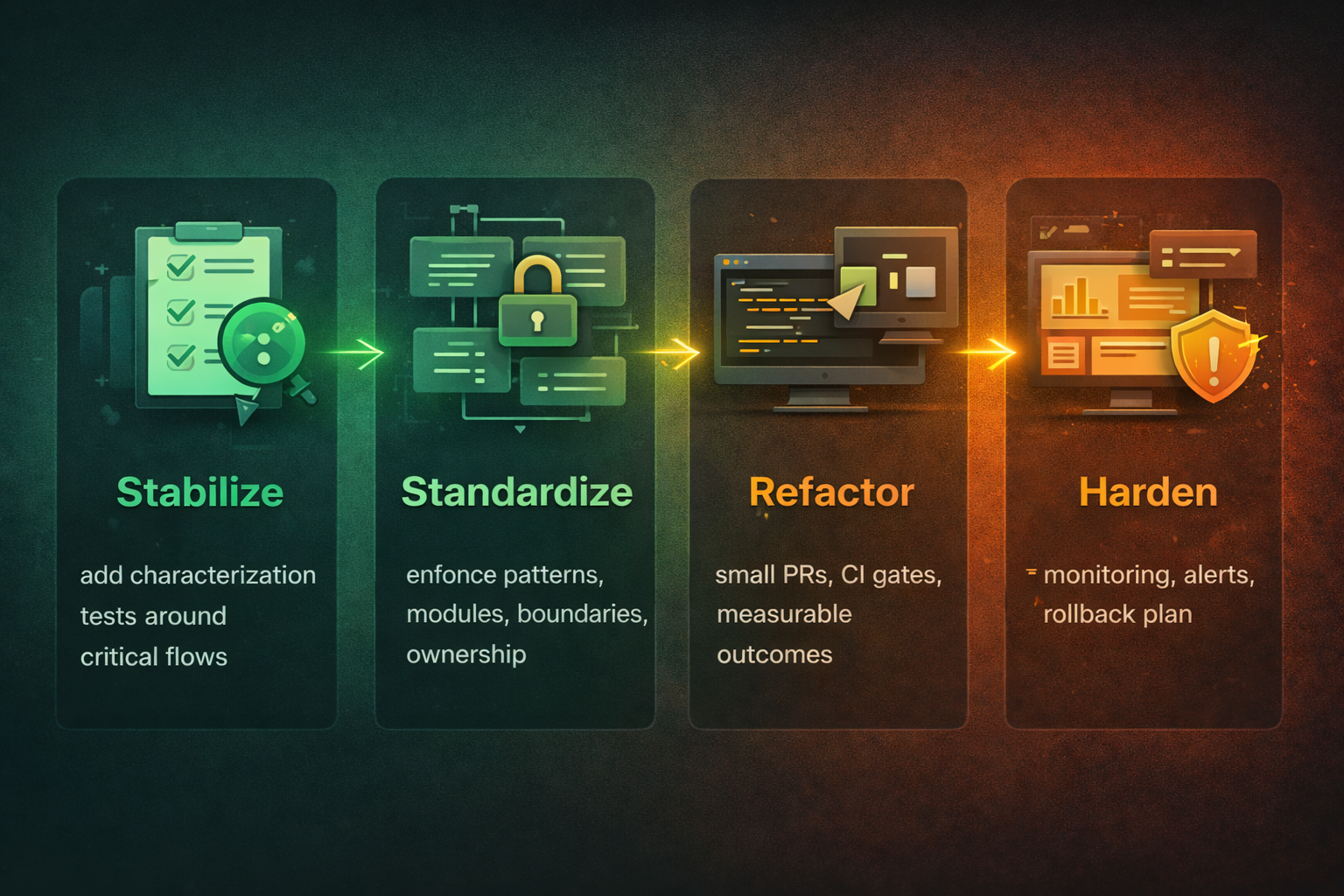
This is the practical side of the advantages of vibe coding over traditional coding: you can move fast - if you keep verification tight.
If You Haven’t Started Yet: The Safer Path
Start AI where governance is easier: internal tools, prototypes, non-sensitive automation. Microsoft’s framing of low-code vs traditional development lands on the same principle: speed is great, but governance and guardrails decide whether it scales.
Final Thoughts
The debate isn’t “AI vs engineers.” It’s whether your workflow includes verification, security, and ownership. Used responsibly, the vibe coding vs traditional coding question becomes a strategy: AI accelerates delivery, traditional engineering keeps the product stable.
In other words: vibe coding and traditional programming aren’t enemies. The best teams treat vibe coding as a power tool - then apply professional practice where risk starts. That’s the real answer to vibe coding vs traditional programming in production.
And if you want a short takeaway: the right vibe coding vs traditional coding comparison is the one that includes maintainability and security - not just speed.
For teams considering a shift from legacy systems to AI-assisted development, AI-driven code modernization offers a pragmatic middle path. Instead of rewriting everything from scratch, structured modernization uses AI to analyze, refactor, document, and gradually transform existing codebases while preserving stability. This approach reduces migration risk, accelerates evolution, and ensures that speed doesn’t come at the cost of maintainability or security.
FAQ
Is vibe coding safe for production?
Sometimes - but only with tests, review, security scanning, and clear ownership. Otherwise, vibe coding vs traditional coding usually ends with incident-driven refactoring.
What’s the difference between vibe coding and AI-assisted development?
AI-assisted development uses AI inside standard engineering (PRs, reviews, tests). Vibe coding often relies on outcomes-first iteration with less code reading - see this Hostinger guide for a clear contrast.
Can AI replace traditional coding?
AI can draft a lot, but it doesn’t replace architecture decisions, threat modeling, and long-term ownership - especially in vibe coding vs traditional programming scenarios with real constraints.
How do you prevent security issues when using AI tools?
Define security requirements upfront, scan dependencies, protect secrets, and force review on high-risk areas. Don’t ship what you can’t explain.
How do you fix a messy AI-generated codebase?
Add characterization tests, isolate modules, standardize patterns, then refactor in small PRs with CI gates. That’s also why vibe coding vs traditional development should never skip testing.
When should a company choose traditional software development?
When the system is long-lived, regulated, security-sensitive, or mission-critical - where maintainability matters more than shipping a demo fast.