

Most organizations face a familiar dilemma: their core systems work but resist change. These platforms keep operations running yet make every update slower and riskier than it should be. The key question isn't whether to modernize - it's how to do it without breaking what currently functions.
This guide outlines strategies that hold up under real-world pressure. You'll find multiple approaches explained clearly, with guidance on when each makes sense. The focus is on helping teams upgrade their infrastructure, applications, and code in ways that reduce risk rather than amplify it - steering clear of both hasty rewrites and systems held together by workarounds.
Why a One-Size-Fits-All Approach to Legacy Modernization Fails
Many modernization initiatives fail for one simple reason: they start with a solution instead of an understanding. “Rewrite it.” “Move it to the cloud.” “Split it into microservices.” Each of these ideas can work - and each can fail spectacularly in the wrong context.
Legacy systems differ in:
- business criticality,
- architectural complexity,
- data sensitivity,
- regulatory constraints,
- and tolerance for downtime.
Business leaders increasingly question whether modernization is always necessary or whether it can be delayed safely. Discussions like do you really need to modernize your legacy systems highlight why modernization decisions should be driven by risk, value, and business context - not trends.
Core Approaches to Legacy Modernization
1. Assessment-First Approach
Applies to
- Business-critical systems
- Poorly documented legacy platforms
- Systems with unknown dependencies
Basics
This legacy modernization approach starts with understanding before changing. Architecture, data flows, integrations, and business processes are mapped before any modernization decision is made. The goal is to reduce uncertainty early, when changes are still cheap.
This approach often includes:
- system and codebase assessment,
- dependency and data flow mapping,
- risk classification,
- modernization roadmap creation.
Example
A financial services platform has grown over 15 years. Multiple teams touched the code, documentation is outdated, and no one fully understands downstream dependencies. Instead of rewriting blindly, the team starts with a structured assessment. Only after identifying safe modernization zones do they move forward - avoiding outages and compliance risks.
Selecting the right modernization path depends on system complexity, technical debt depth, integration landscape, and long-term business goals. While internal teams can experiment with AI-assisted refactoring tools, large-scale modernization typically requires structured governance and phased execution.
For organizations looking for a controlled and production-ready approach, AI-driven legacy modernization services provide a practical next step. This combines AI-powered code analysis with architectural review, risk modeling, regression safeguards, and staged migration — ensuring modernization improves maintainability without introducing new instability.
2. Incremental Modernization Approach
Applies to
- Systems that cannot be taken offline
- Long-lived enterprise platforms
- Products with continuous delivery needs
Basics
The incremental modernization approach modernizes legacy systems in controlled steps. Instead of “big bang” changes, improvements are delivered in small, reversible iterations. This is one of the most widely used approaches to modernize legacy systems in enterprise environments.
Typical techniques include:
- strangler patterns,
- gradual API extraction,
- parallel runs,
- phased data migration.
Example
A logistics platform supports daily operations across multiple regions. Shutting it down is not an option. The team gradually extracts functionality behind APIs, modernizing one domain at a time. Users barely notice the change, but over time the system becomes more modular and easier to evolve.
In engineering practice, incremental modernization often proves more sustainable than large-scale rewrites. Many teams describe similar patterns when sharing real-world experiences with practical legacy system modernization strategies.
3. Business-Driven Modernization Approach
Applies to
- Systems blocking new revenue streams
- Products under competitive pressure
- Platforms tied to business KPIs
Basics
This legacy app modernization approach prioritizes business impact over technical perfection. Modernization efforts are aligned with revenue, cost reduction, compliance, or customer experience goals - not architectural ideals.
Modernization scope is defined by:
- business value,
- time-to-market impact,
- operational cost reduction.
Example
An insurance platform struggles to launch new digital products quickly. Instead of refactoring the entire system, the team modernizes only customer-facing workflows first. The business sees faster launches while deeper technical changes are planned separately.
4. Risk-Controlled Modernization Approach

Applies to
- Regulated industries (finance, healthcare, insurance)
- Systems with strict uptime requirements
- Mission-critical platforms
Basics
This legacy modernization approach treats risk as a first-class constraint. Changes are designed to be reversible, auditable, and compliant from day one. Testing, monitoring, and rollback strategies are built into every modernization step.
This approach emphasizes:
- parallel environments,
- extensive testing,
- observability and monitoring,
- rollback planning.
Example
A healthcare system must comply with strict data protection regulations. Instead of aggressive changes, the team introduces modernization layers around existing systems. Each release is validated against compliance requirements before going live.
5. Code-Centric Modernization Approach
Applies to
- Systems with extreme technical debt
- Hard-to-maintain codebases
- Low architectural flexibility
Basics
This approach focuses on code quality, maintainability, and testability. As part of broader legacy modernization approaches, code-centric modernization reduces long-term risk by making systems easier to change safely.
Common activities include:
- refactoring critical modules,
- introducing automated tests,
- improving observability,
- simplifying complex logic.
Example
A legacy application still meets business needs, but development velocity keeps dropping. Instead of architectural changes, the team invests in refactoring high-risk code paths and adding tests. Over time, releases become faster and safer without changing the system’s external behavior.
Approaches to Modernize Legacy Systems by Legacy Type
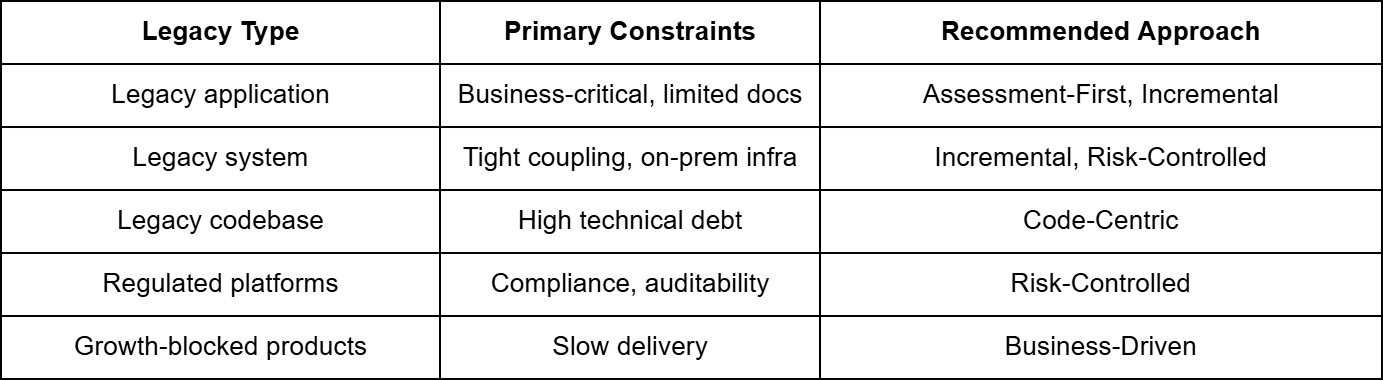
This is why approaches to legacy modernization must vary. Treating application, system, and code modernization as the same problem usually leads to unnecessary risk.
How We Apply Legacy Modernization Approaches in Real Projects
In real projects, modernization rarely follows a single path. Most successful initiatives combine multiple legacy modernization approaches.
A typical engagement looks like this:
- Assessment to understand risk and constraints
- Business-driven prioritization
- Incremental delivery with strict risk controls
- Code-level improvements where they unlock velocity
This layered legacy system modernization approach allows teams to modernize safely while keeping the business running.

If your legacy system limits growth, modernization doesn’t have to mean disruption. The right legacy modernization approach starts with understanding your system, your risks, and your business goals - not forcing a rewrite.
Work with a partner who treats modernization as a controlled, strategic process, not a technical gamble.
Final Thoughts
Legacy modernization is not about replacing old technology with new for its own sake. It’s about restoring the ability to change - safely, predictably, and at the pace the business requires.
The most effective approaches to modernize legacy systems balance business value, technical reality, and risk. When done right, modernization becomes an enabler, not a threat.
Legacy modernization is not just about updating code — it’s about repositioning your technology stack for scalability, automation, and long-term competitiveness.
Companies ready to move beyond incremental refactoring and toward strategic evolution can leverage AI transformation services to align architecture, data, and operations with measurable business outcomes. Instead of isolated upgrades, this approach turns modernization into a coordinated, enterprise-level capability.
FAQ
What is a legacy modernization approach?
A structured way to modernize legacy applications, systems, or code while controlling risk and maintaining business continuity.
How does a legacy app modernization approach differ from system modernization?
Application modernization focuses on functionality and delivery speed, while system modernization addresses architecture, infrastructure, and integrations.
Which approach to legacy modernization is the safest?
Incremental and risk-controlled approaches are generally the safest for business-critical systems.
Can legacy systems be modernized without downtime?
Yes. Incremental and parallel-run approaches allow modernization while systems remain operational.
How long does a legacy modernization project take?
From months for targeted improvements to multiple years for large enterprise platforms.
Is code-level modernization enough for legacy systems?
Sometimes. But in many cases, code modernization must be combined with architectural or system-level changes.