

TL;DR
- This article makes the business case for digital transformation with real examples, data, and a hard look at what happens to companies that wait too long.
- Customer expectations have shifted permanently. Companies that cannot meet them on digital terms lose customers to those that can - and rarely get them back.
- Operational efficiency from digital transformation for business growth is not a soft benefit. It shows up directly in margin and in the ability to scale without proportional cost growth.
- Data-driven decision-making gives transformed organizations a compounding advantage. The gap widens every quarter.
- AI and automation are already opening revenue streams that were not possible five years ago. Early movers are not just cutting costs - they are building new business models.
- Delay is not neutral. Every year without transformation increases the cost and difficulty of catching up.
- Seven reasons digital transformation and business growth are directly connected, which industries face the most pressure, and how to start without disrupting everything at once.
Introduction
Blockbuster had more locations than Netflix had servers. Borders had more floor space than Amazon had warehouses. Both companies had the resources to respond to what was happening in their markets. Neither moved fast enough. The technology was not the differentiator. The willingness to rebuild around it was.
That pattern is playing out faster now and across more industries. McKinsey’s analysis of technology trends consistently shows that the gap between digital leaders and everyone else is getting wider, not narrower. What was a technology gap a decade ago is now a growth gap. Companies with mature digital capabilities grow faster, operate on lower cost structures, and retain talent that legacy-bound competitors cannot attract.
This article covers why digital transformation is essential for business growth - not as a technology argument but as a business one. If you already agree and want the execution framework, the generative AI business transformation roadmap covers the strategy side. Here, the focus is on understanding why the pressure exists and what it costs to ignore it.
What Is Digital Transformation (and What It’s Not)
The importance of digital transformation gets talked around constantly because the term itself is applied to things that do not qualify. Moving documents to the cloud is not digital transformation. Replacing a spreadsheet with software is not digital transformation. Giving employees laptops is not digital transformation.
Digital transformation is the process of fundamentally changing how a business creates and delivers value by integrating technology across all of its operations. The word “fundamentally” is doing real work in that sentence. Forbes puts it plainly: business transformation is a shift in purpose, operating model, and competitive position. Not a tool purchase.
The practical test: if the change could be undone by switching vendors, it probably was not transformation. Transformation changes what the organization is capable of doing, not just which software it uses to do the same things.
Why Digital Transformation Is Essential for Business Growth: 7 Reasons
Reason 1 - Customer Expectations Have Shifted Permanently
The business case: Customers benchmark every interaction against the best digital experience they’ve had anywhere. Not against your industry average - against the smoothest onboarding, the clearest self-service, the fastest support resolution they’ve encountered from any company in any sector. That bar is now set by consumer technology, and it applies to B2B just as much as B2C.
Real example: Retail banks that invested in mobile-first account management saw deposit growth outpace traditional branch-heavy competitors throughout the 2020s. Same product. Different experience. Customers chose on the experience.
Without it: Customer acquisition costs rise as retention falls. Word-of-mouth turns negative. Digital-native competitors absorb the market share that was once protected by switching costs. Those costs are lower now than they have ever been.
Reason 2 - Operational Efficiency Becomes a Competitive Advantage
The business case: The digital transformation business benefits most immediately visible in a P&L are operational. Automating manual processes, connecting systems that previously required human coordination, eliminating data re-entry - these reduce cost per transaction and free capacity for higher-value work. At scale, the margin difference between a transformed and untransformed operation is not marginal. It’s structural.
Real example: Manufacturers that digitized production monitoring and quality control cut defect rates and unplanned downtime significantly. The savings funded further investment. That cycle is how digital leaders compound their advantage.
Without it: The cost structure stays fixed while competitors operating on leaner digital foundations can undercut on price, respond faster to demand changes, or redirect savings into product development. You are not standing still. You are falling behind in relative terms.
Reason 3 - Data-Driven Decisions Replace Gut Instinct
The business case: Organizations with integrated data infrastructure make better decisions faster. They catch underperforming products before they drain resources, spot customer churn signals before the customer leaves, and allocate marketing spend based on actual attribution rather than assumption. The compounding effect of better decisions at every level is significant over time.
Real example: E-commerce companies with real-time inventory and demand data reduced stockouts and overstock simultaneously. They improved gross margin while cutting working capital requirements. That is not an incremental gain. It changes the economics of the business.
Without it: Decisions lag reality. Leadership works from monthly reports that are already out of date by the time they are read. Opportunities close before the signal arrives in a format anyone can act on.
Reason 4 - Digital-First Competitors Are Moving Faster
The business case: Speed of iteration is a structural advantage now. Companies running on modern infrastructure can test a product change, measure results, and ship the winning version in the time it takes a legacy-bound competitor to schedule the meeting to discuss the idea. Digital transformation and business growth are directly connected because growth requires the ability to move fast enough to capture opportunities before they close.
Real example: Direct-to-consumer brands entering categories dominated by established players consistently outperformed expectations by iterating on customer feedback faster than incumbents could respond through their traditional product cycles. The product quality was often comparable. The speed of response was not.
Without it: The competitive gap widens every sprint cycle. There is no stable middle ground here - markets do not wait for organizations to finish their modernization programs before moving.
Reason 5 - AI and Automation Unlock New Revenue Streams
The business case: Artificial intelligence is a production capability, not a research topic. Google’s generative AI use cases span customer service automation, document processing, code generation, and demand forecasting. IBM’s AI transformation research shows that companies deploying AI at scale achieve both cost reduction and revenue growth simultaneously - not as a trade-off.
Real example: Financial services firms using AI for credit underwriting expanded their addressable market by approving customers traditional models would have rejected, while maintaining or improving default rates. They did not just cut costs. They grew the business into territory it could not reach before.
Without it: Competitors use AI to serve customers better, price more accurately, and operate at lower cost. Every quarter of delay is a quarter of compounding advantage handed to them. The AI in industrial automation guide covers how manufacturing organizations are applying this practically if that’s your sector.
Reason 6 - Remote and Hybrid Work Requires Digital Infrastructure
The business case: The workforce model changed. Top performers now treat flexibility as a condition of employment, not a perk. Organizations that cannot support productive remote and hybrid work compete for talent with one hand behind their back. The infrastructure question is not separate from the talent question.
Real example: Technology companies that built cloud-native collaboration infrastructure before 2020 maintained productivity through the disruption period. Competitors scrambling to retrofit legacy systems lost time, output, and in some cases, key employees who did not want to wait for the tools to catch up.
Without it: Talent acquisition is constrained to geographic proximity. Knowledge silos in individuals rather than systems. Employee satisfaction declines when daily work requires workarounds that everyone knows should not exist.
Reason 7 - Scalability Is Only Possible With Digital Systems
The business case: Every fast-growth company hits a ceiling imposed by manual processes. Hiring to handle volume works to a point, then becomes unsustainable. Digital transformation for business growth ultimately removes the constraints that prevent an organization from growing without proportional cost increases. That is what investors are looking for in a unit economics story.
Real example: SaaS companies routinely support order-of-magnitude growth in customer numbers with minimal increases in support headcount. Fully automated onboarding, billing, and self-service infrastructure makes that possible. It is not magic - it is the result of building digital systems instead of manual ones.
Without it: Growth requires linear headcount scaling. Margins compress as revenue increases. The organization becomes operationally complex before it becomes financially mature. That is a ceiling, not a stage.
The Cost of Delaying Digital Transformation
One persistent misconception about why companies need digital transformation is that delay is a neutral choice. That organizations can wait, watch what competitors do, and catch up later at lower cost when the technology matures.
The data does not support this. Each year of delay compounds: competitors extend their capability lead, technical debt accumulates on aging systems, and the organizational change required grows larger and harder. The table below maps seven business areas to the specific impact of inaction.
Industries Where Digital Transformation Is Most Critical
Healthcare
Patient data interoperability, remote care, and AI-assisted diagnostics are moving from differentiators to baseline expectations. Healthcare organizations delaying transformation face regulatory pressure, staff burnout from manual workflows, and patients who now benchmark their care experience against consumer digital products. The gap between expectation and reality is already visible in satisfaction scores.
Financial Services
Fintech entrants proved that banking, lending, and insurance can be delivered with dramatically less friction. Incumbents that cannot match the digital experience while using their regulatory trust and capital advantages are losing ground to platforms built in the last decade. The window for response is narrower every year.
Manufacturing
Predictive maintenance, digital twins, and connected supply chains are shifting manufacturing from reactive to predictive. The digital transformation impact on business in this sector shows up in uptime, yield, and supply chain resilience - all directly affecting margins. The AI in industrial automation integration patterns are worth reviewing if you are in this space.
Retail and E-Commerce
The channel has already shifted. Retailers without integrated online and in-store data cannot personalize at scale, cannot optimize inventory across locations, and cannot match the convenience that digital-first competitors have built into the default customer experience. Catch-up is possible. It gets more expensive each year.
Logistics and Supply Chain
Real-time visibility, route optimization, and demand forecasting are not optional in a sector competing on delivery speed and cost. Manual tracking and disconnected carrier systems are a structural disadvantage when margins are thin and customers now expect to know exactly where their shipment is at any moment.
How CodeGeeks Solutions Accelerates Digital Transformation
Understanding why digital transformation is important is the first step. Building and running the program is where most organizations need outside expertise. CodeGeeks Solutions works with businesses at every stage - from strategy design through scaled implementation.
The digital transformation services cover the full program lifecycle: assessment, roadmap, technology selection, implementation, and measurement. For organizations where AI is the primary driver, the AI transformation services provide a path from first use case to production at scale.
Where legacy systems are blocking progress, AI-driven legacy modernization addresses the technical debt that sits at the root of most transformation bottlenecks. For teams targeting near-term operational gains through automation, AI automation services for businesses connect directly to the process redesign work that produces early ROI. Outcomes from all of these are in the client case studies.
Final Thoughts
The benefits of digital transformation for business are not theoretical. They show up in growth rates, margin profiles, retention numbers, and the ability to attract people who have options about where they work. The companies compounding those advantages today started years ago.
The question is not why digital transformation is essential for business growth - that case has been made by a decade of market outcomes. The question is how quickly an organization can move from recognizing the pressure to executing against it in a way that produces results.
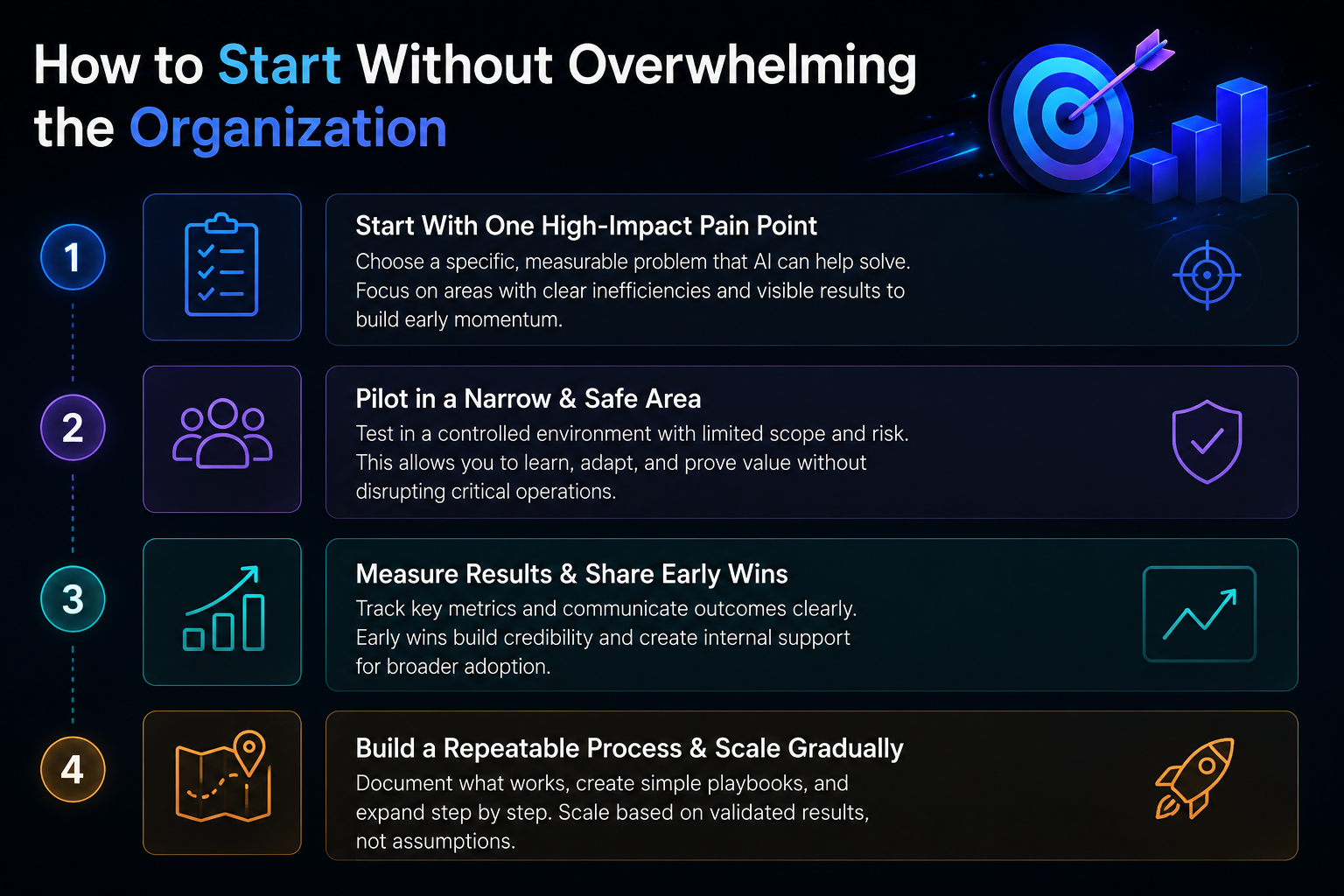
Start with one problem. Measure everything. Build on what works.