
TL;DR
Here's what this article covers, if you want the short version first:
- Agentic AI context engineering is a distinct discipline from standard context engineering - agents run autonomously across dozens or hundreds of turns, so static prompts fail fast.
- The context window is an agent's working memory. Fill it with junk, and you get junk decisions. Fill it with nothing useful, and you get hallucinations.
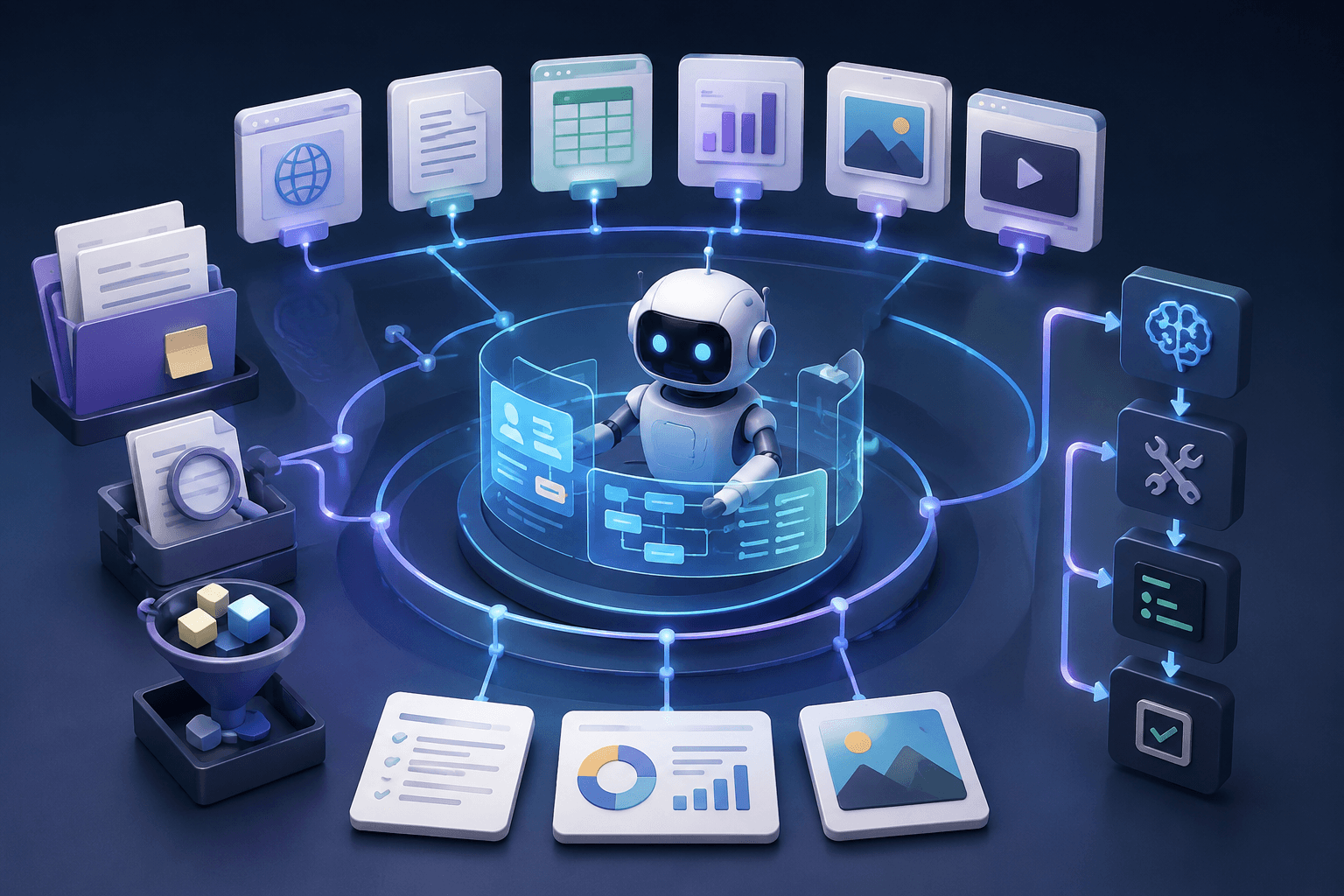
- Four techniques cover most of the practical work: writing context to persistent storage, selecting only relevant context per step, compressing accumulated history, and isolating sub-agent contexts in multi-agent pipelines.
- The ACE (Agentic Context Engineering) framework from Stanford, UC Berkeley, and Salesforce shows that evolving contexts - not weight updates - are the scalable path to self-improving LLM systems.
- Context failure modes in production are predictable: poisoning, collapse, overflow, and isolation failures. Teams that know what to look for catch them before users do.
- Cognizant announced in August 2025 it was deploying 1,000 context engineers specifically to industrialize agentic AI across enterprise clients.
- A practical six-step process for starting with context engineering for AI agents - starting from an audit of your current agent's inputs, not from a clean slate.
Introduction
There was a period when AI agents were mostly theoretical. Then teams started shipping them, and the gap between what a demo does and what a production agent needs to do became very apparent, very quickly.
A demo runs a clean, fixed task. A production agent runs hundreds of turns, calls external tools, manages user-specific state across sessions, and needs to stay coherent from start to finish. That last part - coherence over time, under variable conditions - is where most agents actually fall apart. Not because the model is bad, but because what the model sees at step 47 of a workflow has drifted far from what was originally intended.
This is the problem that agentic AI context management was developed to solve. It's distinct from general context engineering in one important way: you can't design a single, well-crafted context and leave it alone. In agentic systems, context must be actively managed, pruned, and updated at runtime. Anthropic's engineering team describes this as 'context adaptation' - modifying what the model receives as inputs at each step, rather than retraining or fine-tuning the model itself.
This article covers the techniques, failure modes, and practical steps involved in context engineering for AI agents - with a table, real examples, and the research that's driving enterprise investment in this area.
What Is Agentic Context Engineering?
Standard context engineering is about designing what a large language model receives in a given request - structuring the prompt payload intelligently so the model has what it needs to perform well. That framing works fine for single-turn interactions.
Agentic context engineering goes further. It's the practice of designing systems that provide AI agents with evolving, task-relevant context - not a static prompt, but a dynamic information payload that changes at every step of a multi-turn, multi-tool workflow. The agent isn't working from a fixed brief. It's working from a context that was assembled, filtered, and updated specifically for this moment in this task.
The key distinction: agents operate autonomously. They make decisions, call tools, generate intermediate outputs, and use those outputs as inputs for subsequent steps. Every one of those steps changes the information landscape. A context engineering approach that doesn't account for this - that just passes everything forward indiscriminately - quickly produces an agent that contradicts itself, misses important state changes, or runs out of context window before finishing the task.
Anthropic researchers specifically frame it as context adaptation: the idea that runtime modification of inputs is the primary lever for improving agent behavior, not weight updates. That distinction has significant implications for how teams build and maintain production AI systems.
Why Context Matters for AI Agents
Think of the LLM context window as working memory - finite, task-specific, and cleared after each session unless explicitly managed. A human expert working on a long project has notes, files, and their own long-term memory to fall back on. An agent, by default, has only whatever is currently in its context window. That's the entire information universe it can reason from.
When agents run long tasks, context window management becomes a genuine engineering challenge. Tool outputs accumulate. Conversation history grows. Retrieved documents pile up. At some point, the window fills, and something has to give - either the agent truncates important information, hallucinates to fill gaps, or fails outright.
The 'lost in the middle' problem compounds this. Stanford and UC Berkeley researchers showed that models don't attend equally to everything in a long context - they tend to anchor on the beginning and end, treating the middle as relatively unimportant. At around 32K tokens, performance on middle-of-context retrieval tasks started dropping measurably. For an agent running a long task, this means critical state information that was injected at turn 15 might effectively be invisible by turn 40.
Context poisoning is a separate but related problem: when incorrect or outdated information gets injected early in a workflow, it can corrupt subsequent decisions throughout the pipeline. The Prompting Guide's context engineering documentation identifies this as one of the most underappreciated sources of production failures - teams that debug final outputs often never trace the root cause back to a bad retrieval three steps upstream.
There's also what the ACE paper from Berkeley, Stanford, and Salesforce calls 'context collapse' - where iterative summarization over many turns gradually erodes critical domain-specific details, leaving the agent with a smooth but imprecise understanding of what actually happened. The condensed history reads fine. It just no longer contains the specifics the agent needs.
4 Core Techniques of Agentic Context Engineering
Technique 1: Writing Context (Persisting)
The agent doesn't lose important information between steps because that information is written to memory - short-term message history for immediate continuity, or long-term storage (vector databases, knowledge graphs) for facts and strategies that need to survive across sessions. This is what lets an agent know, on turn 50, what it decided on turn 3 - without that information still sitting in the active context window.
Technique 2: Selecting Context
Rather than passing everything into the context, the system pulls only what's relevant for the current step. Semantic search over a vector store, targeted database queries, structured graph lookups - these are all context selection mechanisms. The agent gets signal, not noise. This is particularly critical in agentic AI context engineering because each step in a workflow may require a completely different subset of the available information. Elastic's comparison of context approaches covers this distinction in detail.
Technique 3: Compressing Context
Summarization, selective summarization, and token budgeting all fall here. The goal is retaining only the tokens necessary for the current task while discarding low-value history. The risk is context collapse - over-compression that loses important specifics. Well-designed compression preserves decisions, flags, and key facts while shedding conversational filler and redundant tool output.
Technique 4: Isolating Context
In multi-agent context isolation, each sub-agent operates with its own isolated context window, tools, and environment. This prevents confusion, cross-contamination, and cascade failures across the pipeline. When a code review sub-agent fails, its corrupted context doesn't infect the test-generation sub-agent running in parallel. Isolation is what makes complex multi-agent pipelines stable at scale.
Agentic Context Engineering: Core Techniques Table
| Technique | What It Does | When to Apply | Tools | Example |
|---|---|---|---|---|
| Writing | Persists relevant facts, decisions, and intermediate results to memory or external storage | Any multi-turn or multi-session workflow | Vector DB, knowledge graph, key-value store | Agent stores customer tier and open issue IDs after turn 1; retrieves them at turn 20 |
| Selecting | Pulls only step-relevant context via semantic or structured queries | Before each tool call or reasoning step | Semantic search, SQL, graph query | Code reviewer fetches only files touched by the current PR, not the full repo |
| Compressing | Summarizes and prunes accumulated history to stay within token budget | After N turns or when token count exceeds threshold | Summarization model, token counter, LLM chain | Rolling summary replaces raw message history after 20 turns; preserves decisions, drops filler |
| Isolating | Gives each sub-agent its own context window, tools, and environment | Multi-agent pipelines with parallel or sequential sub-tasks | Agent orchestration frameworks, sandboxed tool schemas | Retrieval sub-agent and reasoning sub-agent never share context; failures don't cascade |
Self-Improving Agents: The ACE Framework
The ACE (Agentic Context Engineering) framework is the research formalization of what engineering teams have been learning through production trial and error. The ACE paper from UC Berkeley, Stanford, and Salesforce - published in 2025 - makes a specific and significant argument: comprehensive, evolving contexts are the scalable path to self-improving LLM systems, not model weight updates.
What this means in practice: instead of retraining or fine-tuning a model every time its behavior needs to improve, you design context systems that evolve over time - learning from past agent runs, updating stored strategies, refining selection criteria based on what worked and what didn't. The model stays the same. The context gets smarter.
The ACE framework was tested on the AppWorld leaderboard, where it matched performance from top production-level agents using a smaller open-source model. The performance gap came from context design, not model capability. That's a striking result - it suggests teams are leaving significant performance on the table by focusing on model selection when context architecture is the actual bottleneck.
For engineering teams, the implication is clear: agentic context engineering platform choices (how you store, retrieve, compress, and update context) will determine how well your agents improve over time, independent of which base model you're running on.
Common Agentic Context Failures
These four failure modes show up repeatedly in production agent deployments. The good news: they're all diagnosable once you know what to look for.
Context poisoning happens when incorrect or outdated facts get injected early in a workflow and then contaminate all subsequent reasoning. A retrieval agent pulls a stale product description; the summarization agent embeds that description into a brief; the final output agent confidently presents wrong information as fact. The error is three steps removed from where it originated.
Context collapse is what happens after many rounds of iterative summarization. Each compression round feels reasonable. Over 40+ turns, though, the agent ends up working from a clean but content-poor summary that's missing the domain-specific specifics that made early decisions make sense. The agent seems coherent. It's actually flying blind.
Context overflow is the most visible failure: the agent hits the token budget mid-task and starts cutting off information, producing truncated outputs, or hallucinating missing context. Harder to diagnose is the slow version - where context approaches the limit and the model starts quietly degrading before it fully breaks.
Context isolation failure in multi-agent systems happens when sub-agents leak context into each other's environments. In a poorly designed pipeline, a retrieval agent's tool output ends up in the context of a generation agent that was never supposed to see it. The generation agent then reasons from data it has no way to verify, and the error often only surfaces several steps later.
Industry Adoption: Who Is Investing in Agentic Context Engineering?
The clearest signal that context engineering for AI agents has moved from research to industry practice came in August 2025. Cognizant announced it was deploying 1,000 context engineers specifically to industrialize agentic AI across enterprise clients. That's not a pilot. That's a headcount decision at a scale that suggests the firm sees context engineering as a core delivery competency, not a specialist edge case.
Anthropic's own engineering team provided a concrete example of what this looks like in practice with Claude Code: rather than loading full database contents into the context window, it uses targeted SQL queries and bash commands to pull only what's needed for the current step. Token efficiency goes up. Retrieval precision goes up. The agent becomes more reliable, not because the model got better, but because the information it receives at each step got more relevant.
Philipp Schmid at Google DeepMind formalized the discipline's importance with his often-cited observation that 80% of agent failures trace back to context problems, not model problems. That framing - context failure as the primary production risk - has been widely adopted across the field and is driving both research investment and hiring decisions.
How to Start with Agentic Context Engineering
Most teams don't start from scratch. They have an agent that mostly works and fails in confusing ways. Here's a practical sequence for getting started:
- Audit what your agent actually receives at each step. Log token counts, inspect full context payloads at each turn, and find where the window starts filling with irrelevant content. You can't fix what you haven't measured.
- Define a structured prompt spec. Formalize persona, task instructions, constraints, available tools, and output schema as distinct, versioned components. This makes context easier to update and test.
- Implement selection. Replace the 'pass everything forward' pattern with targeted retrieval - semantic search, structured queries, or both, depending on your data sources. Context selection in AI agents is usually the single highest-leverage intervention.
- Compress conversation history. Add a rolling summary after N turns - typically 15–25 depending on task complexity. The summary should preserve decisions, flags, and key facts while dropping chitchat and redundant tool output.
- Isolate sub-agent contexts in multi-agent pipelines. Each agent gets its own context window. Shared state goes through explicit memory writes, not implicit context bleed.
- Add context regression tests. When context changes - new retrieval logic, updated compression thresholds, modified tool schemas - run automated tests to catch silent behavior changes before they reach users. Context engineering production AI systems fail quietly without this layer.
How CodeGeeks Solutions Builds Agentic AI Systems
Building reliable agentic systems is most of what our team at CodeGeeks Solutions works on. Our AI automation services for businesses cover the full range of what agentic context management requires: memory architecture, retrieval design, compression pipelines, multi-agent isolation patterns, and the testing infrastructure that catches context failures before they become user-facing problems.
For companies running on older infrastructure, context engineering often can't happen until the underlying stack is modernized. Our AI-driven legacy modernization services handle the foundational work - API surface design, data layer restructuring, and integration patterns that make agentic AI viable on existing systems rather than requiring a rebuild from scratch.
Teams that built fast with LLM APIs and are now debugging inconsistent production behavior often need a structured cleanup pass before they can implement proper context engineering techniques. We also have detailed articles on AI refactoring best practices and the trade-offs between vibe coding and traditional development approaches that are relevant to teams navigating this transition.
You can review what this looks like across different industries and company stages in our case studies. Independent client reviews are also available on our Clutch profile.
Final Thoughts
The picture that emerges from both research and production experience is fairly clear: agentic context engineering isn't an optimization on top of a working agent. For complex, multi-turn, multi-tool AI systems, it's foundational. Agents that lack it don't just underperform - they fail in ways that are difficult to debug because the root cause is invisible unless you're specifically looking at context payloads.
The ACE framework's core finding - that evolving context, not model retraining, is the scalable path to improvement - has real practical weight. It means teams that invest in context architecture compound their gains over time. The agent gets better as the context system gets smarter, without the cost and risk of retraining.
Context engineering tools, selection systems, compression pipelines, and isolation patterns are becoming standard infrastructure for any team building with LLMs at production scale. The question isn't whether to implement them - it's how quickly you can get there before context failures become a user-facing problem.
FAQ
What is agentic context engineering?
Agentic context engineering is the practice of designing systems that manage what an autonomous AI agent knows at each step of a multi-turn workflow. Unlike standard context engineering - which handles a single request - agentic context engineering deals with context that changes constantly: tool outputs accumulate, conversation history grows, retrieved documents evolve. The discipline covers writing context to persistent memory, selecting what's relevant per step, compressing accumulated history, and isolating sub-agent contexts in complex pipelines.
How is agentic context engineering different from RAG?
RAG (retrieval-augmented generation) is one component of context engineering - specifically, it handles the selection technique of pulling relevant documents from external storage. Agentic context engineering is broader: it covers memory architecture, compression strategies, isolation between sub-agents, and the runtime logic that decides what goes into the context window at each step. RAG feeds one input into the context; agentic context engineering designs the full information environment the agent operates inside.
Why do AI agents fail because of context problems?
Because the model reasons only from what it currently sees. If the context window contains stale data, the agent reasons from stale data. If important decisions from earlier turns were compressed away, the agent can't access them. If a retrieval step pulls irrelevant documents, the agent treats them as authoritative. Philipp Schmid's estimate that 80% of agent failures are context failures reflects how completely agent behavior is determined by context quality - and how easy it is to get that wrong in long, dynamic workflows.
What is context compression in LLM agents?
Context compression in LLM agents refers to techniques that reduce accumulated context to fit within token budget constraints while preserving the information the agent still needs. The main approaches are summarization, selective summarization, and token budgeting. The main risk is context collapse: over-compression that discards important specifics.
What is the ACE framework for AI agents?
ACE stands for Agentic Context Engineering. It's a framework developed by researchers at Stanford, UC Berkeley, and Salesforce, published in 2025, that formalizes how context should be managed in self-improving AI systems. Its core argument is that evolving contexts - not model weight updates - are the primary mechanism for improving agent performance over time. In testing on the AppWorld leaderboard, the ACE approach matched top production agents using a smaller open-source model, with performance gains attributable to context design rather than model capability.