

TL;DR
- What it is: an enterprise AI strategy is a company-wide plan that decides where AI will create value, in what order, on which data and controls, and how success is measured.
- Five stages: map opportunities, prioritize, build foundations, pilot, scale. Each has an owner, an output and a clear "done when."
- Choosing use cases: score each idea on value, feasibility, data readiness and risk, then sort into build now, fix first or later.
- What to prepare first: named data owners, access rules, quality checks, production pipelines, security and logging, and monitoring after launch.
- How to measure: adoption, one outcome KPI per use case, cost per task, and quality or risk incidents. Usage alone does not prove value.
What is an enterprise AI strategy?
An enterprise AI strategy is a company-wide plan that links AI investment to business goals. It names the processes where AI should change results, sets the order in which they are tackled, defines the data, platform and governance each one needs, and agrees how value will be measured. A list of tools or a set of pilots is not a strategy; the order and the measurement are what make it one.
The gap between activity and value is now well documented. McKinsey's The state of AI in 2026 found that 44% of respondents say AI is scaling across their organization, up from 38% a year earlier. Yet only 37% report any impact on EBIT, and about 6% qualify as high performers.
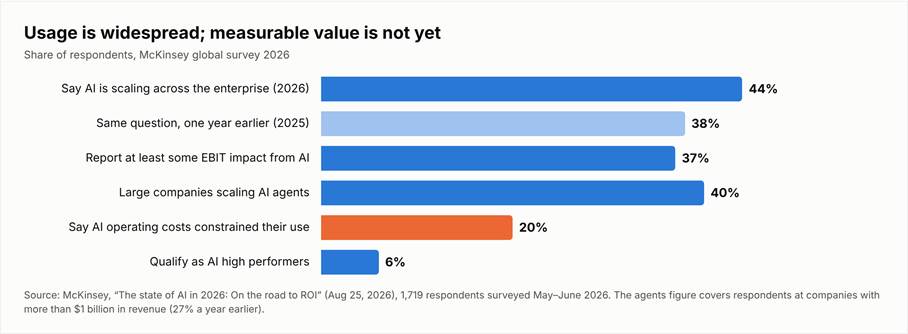
Figure 1. Adoption is rising faster than measurable financial impact. Source: McKinsey, The state of AI in 2026.
Closing that gap is mostly a planning problem, not a model problem. CodeGeeks Solutions works with companies at this point, when AI is in use in several teams but nobody can yet show which projects pay off and which should stop.
Enterprise AI strategy framework: five stages
The framework below keeps the path from idea to company-wide use on one page. Stages overlap in practice, but skipping one usually shows up later as a stalled pilot.
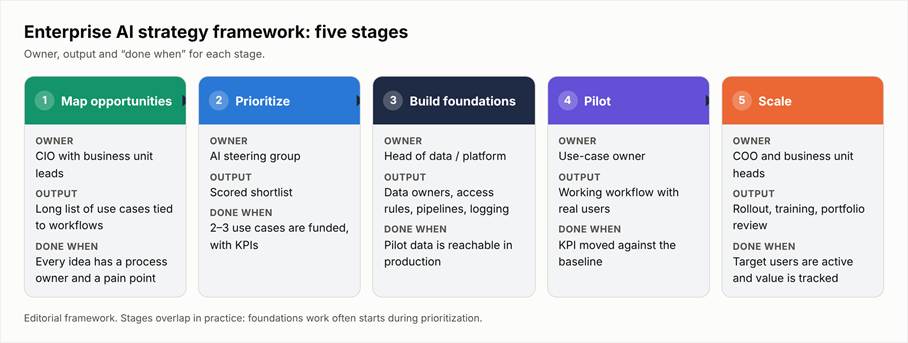
Figure 2. Five stages with owner, output and exit condition.
Table 1. The five stages at a glance
| Stage | Owner | Output | Done when |
|---|---|---|---|
| 1. Map opportunities | CIO with business unit leads | Long list of use cases tied to real workflows | Every idea has a process owner and a named pain point |
| 2. Prioritize | AI steering group | Scored shortlist | 2–3 use cases are funded, with KPIs and a baseline |
| 3. Build foundations | Head of data / platform | Data owners, access rules, pipelines, logging | Pilot data is reachable in production, not only in a sandbox |
| 4. Pilot | Use-case owner | A working workflow used by real users | The KPI moved against the baseline |
| 5. Scale | COO and business unit heads | Rollout plan, training, portfolio review | Target users are active and value is tracked monthly |
AI opportunity mapping and use case prioritization
Good use cases come from workflows, not from technology. Three sources produce most of them: high-volume processes with repetitive judgment (claims, invoices, tickets), places where data exists but nobody has time to read it (contracts, call notes, inspection reports), and pain points that teams already complain about, such as slow onboarding or manual reporting.
Once the long list exists, each idea gets a score from 1 to 5 on four dimensions: business value, technical feasibility, data readiness and risk (where 5 means low risk). The table shows how this works on six typical examples. It is an illustration, not data from a survey.
Table 2. Use-case scoring (illustrative example)
| Use case | Value | Feasibility | Data readiness | Risk (5 = low) | Verdict |
|---|---|---|---|---|---|
| Invoice extraction and matching | 4 | 5 | 4 | 4 | Build now |
| Support ticket triage and draft replies | 4 | 4 | 4 | 4 | Build now |
| Sales forecasting on CRM data | 5 | 3 | 2 | 4 | Fix first: data quality |
| Internal policy assistant | 3 | 5 | 2 | 4 | Fix first: outdated documents |
| Contract review assistant | 4 | 3 | 3 | 2 | Fix first: governance and review steps |
| Autonomous purchasing agent | 5 | 2 | 2 | 1 | Later |
The verdict matters more than the total. A high-value idea with poor data is not rejected; it moves to "fix first," and the data work becomes part of the foundations stage. CodeGeeks Solutions uses a similar logic in its digital transformation roadmaps, ranking initiatives by impact, effort and dependency risk, so the plan reflects what blocks what.
Enterprise data and AI strategy
Most stalled pilots fail on data, not on models. Gartner predicts that through 2026, organizations will abandon 60% of AI projects that are not supported by AI-ready data. A short yes/no checklist shows whether the first use cases have what they need.
Table 3. Data and AI foundation checklist
| Check | Yes / No |
|---|---|
| Each data set used by the first use cases has a named owner | ☐ |
| Access rules define who and what (including AI agents) can read each source | ☐ |
| Data quality checks run automatically, with alerts on failure | ☐ |
| Pipelines deliver data to production systems, not only to notebooks | ☐ |
| Security and logging cover AI inputs, outputs and actions | ☐ |
| Models and workflows are monitored after launch for quality, cost and drift | ☐ |
Any "no" belongs on the roadmap before the pilot starts, not after it.
Not sure which AI use cases to fund first?
CodeGeeks Solutions can run a short mapping and scoring session with business and IT leads, using the method above, and leave the team with a ranked shortlist and the data work each use case needs. Start with the AI transformation team.
Enterprise generative AI strategy
Generative AI and agents change three things in planning: what data is needed, what can go wrong and how costs behave.
Table 4. What changes with generative AI and agents
| Aspect | Traditional ML | Generative AI | AI agents |
|---|---|---|---|
| Typical use | Forecasts, scoring, classification | Drafting, summarizing, search over documents | Multi-step tasks that use tools and systems |
| Data needed | Labeled, structured history | Clean, current documents and access rules | All of that, plus permissions for each system |
| Main risk | Biased or stale predictions | Wrong but convincing answers, data leakage | Wrong actions, privilege abuse, runaway loops |
| Cost behavior | Mostly fixed after training | Grows with usage (tokens per request) | Grows with steps per task; less predictable |
The cost row deserves attention in budgets. In McKinsey's 2026 survey, about 20% of respondents said AI operating costs, including tokens, had constrained their use. A business case should therefore estimate cost per task at full volume, not at pilot volume. Model choice and prompt engineering are the main levers for keeping that number down.
AI agents in the enterprise strategy
Agents belong in the plan, but usually after the first workflows are stable and the data they need is accessible through governed interfaces. An agent amplifies whatever it is built on: clean data and clear rules make it useful, while messy data and broad permissions make it risky. McKinsey reports that 40% of respondents at companies with more than $1 billion in revenue are now scaling agents in at least one function, up from 27% a year earlier. Gartner, meanwhile, expects over 40% of agentic AI projects to be canceled by the end of 2027 because of cost, unclear value or weak risk controls. The practical reading: add agents to proven workflows with clear owners, starting with one agent, not a fleet. The building blocks of an AI agent stay the same whether it supports one team or many.
Governance and operating model
Governance answers three questions: who decides, who owns each use case, and how often the portfolio is reviewed. A common model is a small AI steering group (CIO or CTO, a business sponsor, the head of data, security and legal) that approves use cases and budgets. Each use case then has one business owner responsible for its KPI and one technical owner responsible for quality and cost. The NIST AI Risk Management Framework gives a useful structure through four functions: Govern, Map, Measure and Manage. A quarterly portfolio review, where each use case either earns more budget, gets fixed or is stopped, keeps the enterprise AI strategy honest.
Roadmap and metrics: from pilot to scaled adoption
A first enterprise AI strategy roadmap does not need to cover five years. Twelve months is enough to prove the method and fund the next round.
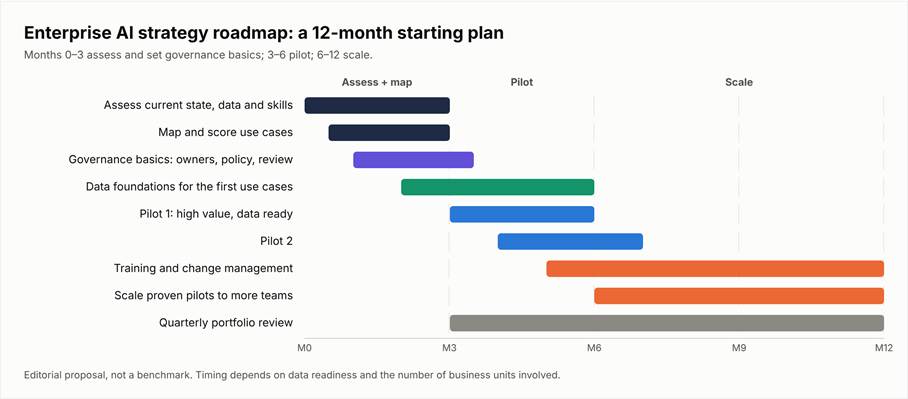
Figure 3. A 12-month starting plan: assess and map (months 0–3), pilot (3–6), scale (6–12).
Four KPIs are enough to start:
Table 5. Starter KPI set
| KPI | What it shows | Example |
|---|---|---|
| Adoption | Share of target users active each week | 70% of support agents use the triage assistant weekly |
| Outcome KPI per use case | The business result the use case was funded for | Invoice processing time, first-contact resolution |
| Cost per task | Full running cost divided by completed tasks | Cost per processed invoice, including tokens and review time |
| Quality or risk incidents | Errors, escalations and policy breaches | Wrong refunds, data exposures, customer complaints |
Adoption alone is not value. McKinsey's figures show high usage alongside limited EBIT impact, which is exactly what happens when adoption is the only metric tracked. Each use case needs its outcome KPI and a baseline measured before the pilot starts.
How CodeGeeks Solutions approaches AI strategy
CodeGeeks connects strategy work to delivery: the same team that scores use cases also builds the data foundations and the first workflows. Three published examples show the approach.
One AI agent inside a daily workflow
Situation: an inspection business needed technicians, administrators and clients to work from one system. What was built: a role-based Inspection Management Platform with an AI agent working inside the daily inspection workflow. Result (per the case study): 60% faster access to reports, 2.5x faster onboarding and a 42% boost in data accuracy.
Data foundation first, then AI
Situation: a marketing data business needed to search a very large data set much faster. What was built: a Lead and Data Intelligence System where the data pipeline came first and LLM steps were added on top of it. Result (per the case study): search time reduced from three hours to 20 minutes across more than 184 million records.
Phased modernization before scaling AI
Situation: a European hardware manufacturer needed to modernize legacy systems before AI could be used at scale. What was built: a phased modernization program under a 12–18 month roadmap, described on the AI-driven legacy modernization page. Result (as reported by CodeGeeks): 35% lower operational overhead and 2x faster insights.
“Data readiness decides the order of use cases more often than business value does. A high-value idea built on data that has no owner tends to stall in the pilot. We put that data work on the roadmap first and start with a use case whose data is ready, so the company sees a result while the foundations catch up.”
— CodeGeeks Solutions AI engineering team
Turn the shortlist into working AI
CodeGeeks Solutions is an AI-native product engineering partner: it helps organizations automate operations, modernize legacy systems and build AI-enabled products on secure, dependable data foundations. For companies that already know their first use cases, the next step is a pilot that runs on real data with real users. See how CodeGeeks builds AI automation and plan the first production workflow.
FAQ
What is an enterprise AI strategy?
An enterprise AI strategy is a company-wide plan that connects AI investment to specific business outcomes. It decides which processes AI should improve, in what order, with which data and controls, and how results will be measured.
The plan usually covers five areas: a prioritized portfolio of use cases, the data and platform foundations those use cases need, governance with clear owners and review points, a roadmap with dates and budgets, and a small set of metrics. What separates a strategy from a collection of pilots is sequencing and accountability. Each use case has a business owner, a baseline and a target, and the portfolio is reviewed regularly so that projects which do not deliver are fixed or stopped.
A good strategy also recognizes dependencies. A forecasting project may need a data cleanup first, and an agent may need stable access rules before it can safely act on business systems. The document itself can be short; what matters is that the decisions in it are made and followed.
What should an enterprise AI strategy include?
At minimum, it should include five elements. First, a scored portfolio of use cases with a verdict for each: build now, fix first or later.
Second, a description of the data and platform foundations the first use cases require, including data owners, access rules, quality checks, pipelines to production, and security and logging. Third, a governance model that names who approves investments, who owns each use case and how often progress is reviewed; frameworks such as the NIST AI Risk Management Framework help structure this. Fourth, a roadmap, typically 12 months for the first version, that moves from assessment to pilots to scaling.
Fifth, a short list of metrics: adoption, an outcome KPI per use case, cost per task, and quality or risk incidents. Many strategies also include a section on skills and change management, because tools that employees do not trust or understand rarely deliver value. Budget assumptions should reflect running costs at full volume, not pilot costs.
How do you choose the first AI use cases?
Choose use cases that combine clear business value with data that is ready today and a manageable level of risk.
Start by collecting ideas from real workflows rather than from technology demos: high-volume tasks with repetitive judgment, document-heavy processes and known pain points. Then score each idea from 1 to 5 on value, feasibility, data readiness and risk. Ideas that score well across all four become pilots. Ideas with high value but weak data move to a "fix first" list, and the data work goes into the roadmap.
Ideas with high risk and low readiness wait. Good first candidates often include invoice processing, support ticket triage and internal search over well-maintained documents, because they have measurable outcomes and contained risk. Avoid starting with fully autonomous agents that spend money or change customer records. Finally, make sure each chosen use case has a business owner who will measure the baseline before the pilot starts; without a baseline, success cannot be proven.
How long does it take to build and start an enterprise AI strategy?
A first version can usually be built in two to three months, with pilots running within six. The assessment and mapping phase, which covers current systems, data, skills and candidate use cases, often takes a few weeks.
Scoring and roadmap work adds several more. CodeGeeks, for example, describes its digital transformation engagements as an assessment of 2–4 weeks, a roadmap of 3–6 weeks and a pilot of 4–8 weeks. The full cycle from first workshop to scaled use across several teams typically takes about a year, which is why a 12-month roadmap is a practical starting horizon.
The main factor that stretches timelines is data readiness: if the first use cases depend on data that has no owner, poor quality or no production pipeline, that work comes first. Organizational factors matter too, including how quickly a steering group can approve budgets and how many business units are involved. Strategy is not a one-time exercise; the portfolio should be reviewed every quarter.
How do you measure whether an enterprise AI strategy works?
Measure outcomes, not activity. Four metrics cover most needs.
Adoption tracks the share of target users who actively use each AI tool, which shows whether people trust it. An outcome KPI per use case, such as processing time, resolution rate or revenue per account, shows whether the business result has moved against the baseline. Cost per task divides the full running cost, including tokens, infrastructure and human review, by completed tasks, which reveals whether the economics hold at scale. Quality and risk incidents count errors, escalations and policy breaches.
Usage on its own can mislead. McKinsey's 2026 survey shows AI use is widespread while only a minority of respondents report EBIT impact, a gap that appears when adoption is tracked and outcomes are not. At the portfolio level, review results quarterly and decide for each use case whether to scale it, fix it or stop it. A strategy that never stops a project is probably not measuring closely enough.