
TL;DR
- A successful pipeline can still feed an AI product yesterday's facts; end-to-end evidence catches the gap.
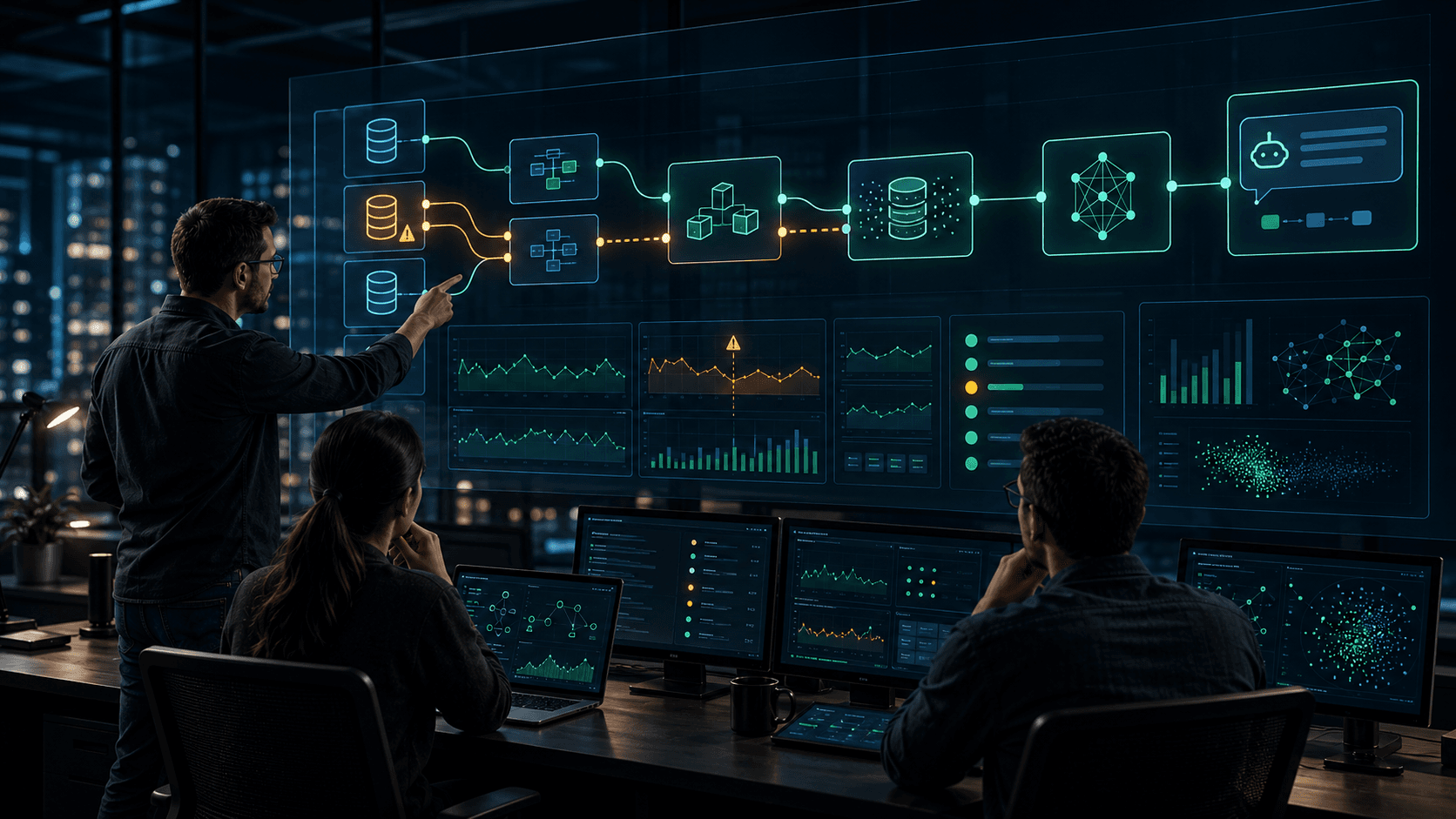
- For RAG and agent systems, watch the trip from source to index to answer — not just the job that moved the data.
- No owner, no useful alert: include impact, evidence, and the component at fault.
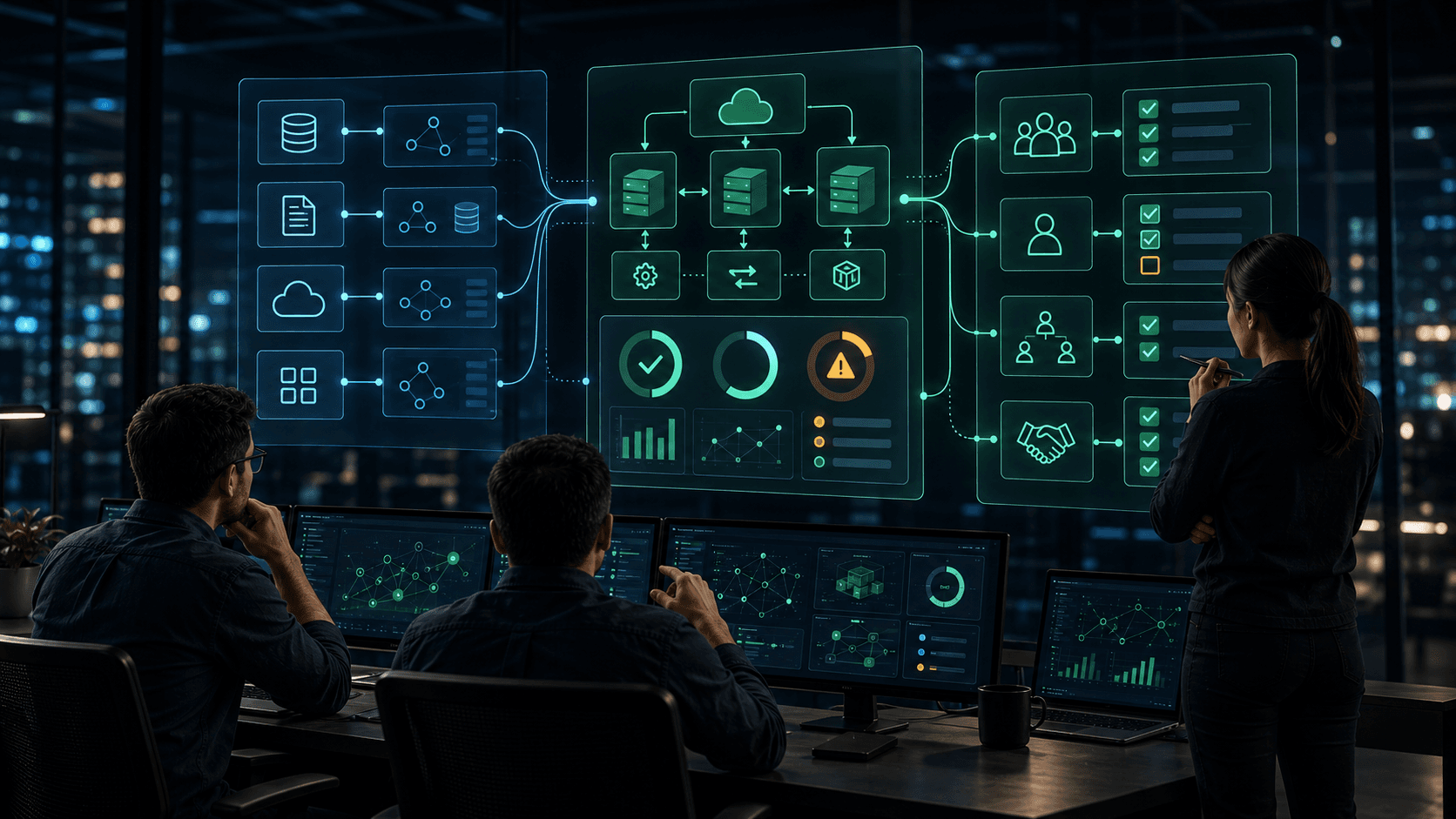
- The architecture should connect source, pipeline, storage or index, AI consumer, output, and incident response.
- Use AI to detect changing patterns and group signals, while retaining fixed rules for contracts, access, and irreversible actions.
Introduction: Why Green Pipelines Can Still Produce Wrong AI Answers
Data observability for AI connects the condition of source information to the behavior of the product consuming it. A pipeline can complete successfully while an assistant retrieves an outdated policy, a model receives a shifted distribution, or an agent uses content that should never have crossed an access boundary.
Microsoft Security's March 2026 example shows why conventional health metrics can mislead: an email agent delegated research, ingested poisoned web content, and later sent sensitive material while the dashboards stayed green.
A supplier changes a field on Friday; Monday's pipeline completes; the recommendation service quietly loses one product category. Or a policy changes while the vector index serves its previous version.
This discipline follows information from the source to the model, retrieval system, or agent using it. Quality checks remain part of the picture, while AI observability covers the wider application — prompts, outputs, latency, spend, safety, and tool calls. Microsoft Security puts the limitation plainly: “We need to evolve the types of signals and telemetry collected.” A disputed answer should be traceable to its source version, transformations, index state, permissions, and retrieval result. CodeGeeks Solutions treats that evidence path as part of the product architecture, not as a dashboard added after launch.
Data Observability for AI Readiness
Readiness has the same time problem. A launch-day review expires quickly after a schema edit, permission change, late batch, or model migration. Gartner's Roxane Edjlali states the core test plainly: “If the data has issues, then the data is not ready for AI.” Continuous evidence supplies the answer after launch.
Apply the scorecard to a named product. A weekly report and a real-time agent may require different freshness, rights, and representation from the same table.
| Readiness check | Evidence to request |
|---|---|
| A named owner accepts alerts and quality decisions | Owner and escalation record |
| Freshness and availability expectations are defined | SLO or contract |
| Schema and transformation changes are detected | Version and change logs |
| Completeness and distribution are monitored | Current dashboard and alert history |
| Lineage reaches the model, index, report, or agent | Lineage view or trace |
| Sensitive data and access are observable | Access logs and classification |
| Incidents have a response and recovery path | Runbook and recent exercise or incident |
| RAG indexes and source documents have freshness controls | Index status and source timestamps |
| Retrieval or context quality is evaluated | Evaluation set and results |
This is data observability for AI in readiness terms: the evidence remains current after the initial assessment and reaches the actual model, index, report, or agent.
Data Observability Metrics for AI
The first monitoring choices should follow business consequences. RAG adds source-to-index delay, the version retrieved, provenance, access decisions, and evaluation queries with known evidence. A completed re-index does not prove that ranking quality survived an embedding change.
| Metric | Why it matters for AI | Owner | Example alert |
|---|---|---|---|
| Freshness | Stale inputs can produce outdated predictions or retrieval | Data product owner | Delivery misses the agreed freshness window |
| Volume | Missing or duplicated batches may distort behavior | Pipeline owner | Volume moves outside an approved baseline band |
| Schema | Type, field, and contract changes can break transformations silently | Source and pipeline owners | Required field disappears or changes type |
| Completeness | Missing values may affect features, filters, and context | Data owner | Critical-field null rate exceeds the use-case limit |
| Distribution drift | Input patterns can move away from evaluated conditions | Data scientist / ML engineer | Material feature or category shift is detected |
| Lineage coverage | Teams need to locate affected models and agents | Data platform owner | A production input has no trace to its consumer |
| Index freshness | RAG may retrieve an outdated version after source change | Retrieval owner | Source update is not indexed within the agreed window |
| Retrieval hit rate | Weak retrieval leaves the model without required evidence | AI product owner | Evaluation queries fail to retrieve expected sources |
| Embedding drift | Provider, model, or content change can alter retrieval behavior | ML / retrieval engineer | Evaluation quality drops after embedding change |
Useful measures identify the affected consumer, comparison baseline, and owner. They also explain how recovery will be proved. “The pipeline ran again” is not enough when the damaged record has already reached a feature store, three reports, and an agent's persistent memory.
Data Observability Architecture
Architecture follows the data path rather than a vendor category. A workable design covers the whole trip taken by the data:
| Layer | What to observe | Typical owner |
|---|---|---|
| Sources | Availability, schema, access, extraction, source timestamp | Source-system and data owners |
| Pipelines | Runs, retries, latency, volume, transformation tests, code version | Data engineering |
| Storage and indexes | Tables, features, documents, vectors, freshness, permissions | Data platform and retrieval teams |
| AI consumer | Dataset or index version, retrieval, input drift, failed context | ML / AI product team |
| Outputs | Quality, provenance, downstream use, correction and complaint signals | Product and business owner |
| Response layer | Alert routing, severity, diagnosis, rollback, correction, closure | Shared incident owner |
At the source, observe availability, extraction, schema, and access. Through transformation, retain run history, code versions, tests, retries, and timing. Storage and retrieval layers add table, feature, document, vector, freshness, and permission state. The consuming product contributes its dataset or index version, retrieval evidence, and downstream quality signals. Alert routing and incident handling connect those pieces into something a team can operate.
With one warehouse and mature orchestration, extend existing contracts, tests, metadata, and lineage before adding another platform; check where those controls stop short of RAG, agents, or product outcomes. A multi-cloud estate with many data products may justify specialist connectors and investigation views, but integration effort, portability, and alert quality become part of the decision. A proprietary workflow may need custom signals around the existing platform, together with explicit ownership for the long-term operating workload.
CodeGeeks Solutions' AI Transformation Services can map the gaps while retaining the parts of the current stack that work. For retrieval systems, its Context Engineering vs Prompt Engineering guide explains why context quality depends on the sources, retrieval process, permissions, and state around the prompt.
AI for Data Observability and Monitoring
Static rules remain the right choice when the expectation is explicit. A required field must be present, a schema must match its contract, a restricted column must not reach an unauthorized user, and a batch must arrive before its deadline. Those checks are explainable and should fail consistently.
AI adds value where “normal” changes with weekday, season, campaign, region, customer segment, or combinations of several weak signals. A model can learn those baselines, group related alerts, rank plausible upstream causes, and summarize the evidence for a responder. That may reveal a gradual shift that never crosses one fixed threshold or reduce the noise created by dozens of symptoms from the same incident.
The detector is not the decision owner. It can drift, amplify historical blind spots, and produce false confidence when a source or business pattern changes. Retain the input signals, comparison baseline, model or rule version, and reason for each recommendation. Review missed incidents and false positives with a named owner, and test alert quality again after material changes.
Automated remediation should start with narrow, reversible actions inside existing permissions, such as pausing a downstream refresh or routing a suspect batch for review. Access changes, destructive corrections, external notifications, or business decisions still need explicit controls and, where consequences are material, human approval. Applied carefully, AI can improve detection and investigation without replacing contracts, access rules, or accountable incident response.
Implementation Steps
Inventory
Working question: Which source, transformation, store, index, and owner sit behind this outcome?
Output: Dependency map.
Prioritize
Working question: Which three to five quiet failures would be costly or difficult to see?
Output: Risk-based first scope.
Baseline
Working question: What is the normal range, what business impact matters, and who receives the alert?
Output: Calibrated, owned monitors.
Exercise
Working question: Can a responder find downstream impact, roll back, communicate, and prove recovery?
Output: Tested incident runbook.
Extend
Working question: Which retrieval, context, access, and product signals remain uncovered?
Output: End-to-end data observability for AI pipelines.
| Incident record | Evidence to retain |
|---|---|
| Detection | First bad timestamp, signal, baseline, and severity |
| Scope | Affected datasets, indexes, models, agents, reports, and users |
| Correction | Data, code, configuration, or permission change applied |
| Recovery | Proof that each affected consumer received the corrected version |
| Notification trail | Audience, timestamp, decision, impact, and current status |
| Follow-up | Named owner, due date, prevention check, and final validation |
| Lessons | Root cause, control gap, prevention decision, and review date recorded |
Common Mistakes
- Estate-wide monitoring before the product-critical flows.
- Shipping ownerless alerts with no severity or response expectation — effectively creating a notification backlog.
- Letting noise accumulate until the team stops looking.
- Watching tables while forgetting documents, messages, vector indexes, and other unstructured sources.
- Declaring the setup “done” while the products, models, permissions, and data continue to change.
How CodeGeeks Solutions Can Help
CodeGeeks Solutions is an AI-native product engineering partner that helps organizations automate operations, modernize legacy systems, and build AI-enabled products on secure, dependable data foundations. For observability work, that means mapping sources, consumers, owners, controls, and blind spots, then implementing lineage, pipeline and index instrumentation, quality gates, retrieval checks, response routing, and recovery evidence around the product that uses the data.
The published Lead and Data Intelligence System case handled more than 184 million records. Search and data management fell from three hours to 20 minutes, uploads became 50 times faster, and the case reports a 38% increase in marketing campaigns. These figures describe that application; they are not promises about observability results.
Where remediation can be bounded and reversed, CodeGeeks Solutions' AI Automation Services for Businesses can support routing, triage, and controlled action within defined permissions.
The sensible starting question is not “Which observability platform should we buy?” It is “Which three data failures would damage this AI product without setting off today's alarms?” Once those are named, CodeGeeks Solutions can map the missing signals, ownership, and incident path while building on the stack already in place.
FAQ
1. What is data observability for AI?
It is the operating evidence that connects an AI result to the information behind it. A policy may be updated while the assistant still retrieves an older index, even though every pipeline job is green. The observability record shows the source and index version, where the update stopped, which products used stale material, and who owns recovery. Unlike a one-time data-quality review, it remains useful after launch and changes with the product.
2. How is data observability different from data quality and AI observability?
Data quality asks whether information is fit for a particular use. Data observability follows a defect through sources, transformations, indexes, and downstream consumers, then directs the incident to an owner. AI observability examines what the application did once those inputs arrived: prompts, retrieved context, model output, tool calls, latency, spend, and user outcome.
The three views meet during an incident. Quality identifies the broken expectation, data observability finds the path and affected products, and AI observability reveals the resulting behavior. Together they replace guesswork about whether data, retrieval, or the model caused the failure.
3. What metrics should I monitor for AI data pipelines?
For AI data pipelines, begin with freshness, volume, schema, completeness, distribution, and lineage. Retrieval systems also need source-to-index delay, retrieved version, expected-document retrieval, access violations, and changes in embedding or evaluation performance. Track detection time, recovery time, affected consumers, and wrong or late downstream outcomes.
Thresholds should follow the business consequence. A two-minute delay is harmless for a weekly report and serious for live pricing. An alert is useful only when it says what changed, which product behavior may be affected, and who is expected to act.
4. How do I know if my data is ready for AI?
Readiness belongs to a job, not to a dataset in isolation. Name the user, decision or action, deadline, and acceptable failure. Then test ownership and permitted use, representative coverage, freshness, transformation behavior, and traceability into the model or retrieval index.
Recovery is part of the answer. Someone must detect a broken feed, identify affected products, and restore or fall back within the required time. The same table may support weekly analysis and fail a real-time agent. AI-ready data therefore means current evidence for one use, not a permanent company-wide label.
5. Can AI improve data observability and monitoring?
Yes, especially where “normal” changes by weekday, season, campaign, or region. A detector can combine weak signals, group several symptoms into one incident, rank plausible upstream causes, and summarize evidence for the responder. Fixed rules should remain in place for schema contracts, required fields, access boundaries, and delivery deadlines.
The detector also needs supervision. Review missed incidents and false alarms, retain the reason behind each recommendation, and retest after source or model changes. Automate corrective action only when it is narrow, reversible, and already allowed by policy.